Most wrapping paper doesn’t run out. It gets crushed, unrolls into a tangle at the back of a closet, or tears along the edge, and then you buy more. Add the tape that’s never where you left it and you’ve lost twenty minutes before the first gift is wrapped. A little storage fixes all of that, and most of it costs nothing.

Stand rolls upright or hang them, never lay them under heavy things. Keep tape, scissors, tags and a pen together in one caddy. File gift bags and tissue flat by size. Then trim the collection so it fits the space you gave it.
Rolls
1. Stand them up in a tall bin
The simplest fix: a tall, narrow bin or a clean kitchen trash can in a closet corner. Rolls stand on end, nothing sits on top of them, and you can see every pattern at a glance.
Try it if you have a closet corner with a free square foot of floor. Measure your tallest roll first; many are taller than a standard bin.
2. Slide a long box under the bed
Gift-wrap storage boxes are made long and flat for exactly this. They hold rolls lying down with nothing pressing on them, plus a lid to keep dust off. Measure the clearance under your bed and the length of your longest roll before you buy; our under-bed storage guide shows how.
3. Hang rolls on clip hangers
A skirt or pants hanger with clips holds two or three rolls by their ends and hangs on the closet rod like clothing. It takes almost no space and keeps the edges from getting bent.
4. Use the back of a door
A clear over-the-door shoe organizer puts rolls in the long pockets and tape, tags and ribbon in the small ones. Everything is visible, and the door closes as usual. Check the hooks fit over your door before buying.

5. Stop rolls from unrolling
Cut an empty paper-towel or toilet-paper tube lengthwise and wrap it around the roll like a cuff. It holds the paper tight and protects the edge. A loose elastic band works too, as long as it isn’t tight enough to crease the paper.
Ribbon, tape and tags
6. Put ribbon on a rod
Thread spools onto a paper-towel holder, a short tension rod or a wooden dowel set across a shoebox. You can pull and cut exactly what you need without the spools tangling together.
7. Make one wrapping kit
Tape, scissors, gift tags, a pen and a small ruler go in one handled caddy or a pencil case. It lives with the paper, and nobody borrows the scissors without knowing where they go back.
Try it if you spend the first ten minutes of every wrapping session looking for tape.
8. Keep bows in a clear box
Stick-on bows crush easily in a bag. A clear, lidded box keeps their shape and lets you see colors without opening it. Store it on top of the other supplies, never underneath.

Bags, tissue and the leftovers
9. File gift bags by size
Flatten gift bags and stand them in a magazine file or a file box, small to large. Reused bags are a bargain, but only if you can find the right size in December.
10. Keep tissue flat in a folder
Tissue paper wrinkles the moment it’s stuffed in a bag. A large art portfolio or a flat document box keeps it smooth and slides behind a dresser or under the bed.
11. Split holiday and everyday wrap
Christmas paper only needs to be reachable for six weeks a year. Keep birthday and all-occasion wrap in the easy spot, and holiday wrap in the bin that goes to the back of the closet or garage in January.
Where to wrap
12. Turn a rolling cart into a station
A three-tier rolling cart holds the kit on top, ribbon and bows in the middle and bags at the bottom, with rolls standing in a bin beside it. Roll it to the dining table to wrap, then back into a closet.
13. Trim the collection to fit
If the rolls don’t fit the bin, the bin isn’t the problem. Keep three or four holiday patterns you like and one or two all-occasion rolls, and pass the rest to a friend or a school craft drive.
If you need a few pieces
Ready for one container that holds everything? Our best gift wrap organizers compares five, from an upright box to an over-the-door holder, by size and roll capacity.
Affiliate disclosure: As an Amazon Associate I earn from qualifying purchases. These links open Amazon search results for the item types above, not recommendations for a specific model. Measure your rolls and your space first.
General organization ideas, not a hands-on product test. See our editorial policy.
Related: Craft supply storage ideas
Keep reading
More guides for your space
THE KINDRED JOURNAL
Latest from the journal
- Best Gift Wrap Organizers: 5 Picks for a Closet Corner, Under the Bed or the Back of a Door
 An upright box that holds up to 32 long rolls, a 41.5-inch under-bed bag for big collections, a water-resistant zip bag, an over-the-door organizer and a slim canvas case for eight rolls: five gift wrap organizers matched to the space you can give them.
- Cord and Cable Storage: 13 Ideas for the Spare Chargers, Cables and Adapters Nobody Can Find
 Match every cable to a device you still own, keep a sensible number of spares by connector type, coil them loosely, label the mystery bricks, hang the extension cords and send old batteries and dead cables to a proper drop-off: thirteen ways to store spare cords so the right one turns up in seconds.
- Window Condensation in Winter: Find Which Side the Water Is On, Then Match Humidity to the Forecast
 Do the wipe test to tell room-side fog from a failed seal, check a hygrometer against the outdoor low, keep humidity at or under 40% above 20°F and 30% below 10°F, run the fans, open the curtains by day and dry wet sills the same morning: a window condensation guide with a worked cold-week example.
- How to Clean a Range Hood Filter Before Holiday Cooking: Know Your Filter Type, Then Put It on the Calendar
 Wash metal mesh and baffle filters in hot soapy water or the dishwasher, replace charcoal filters instead of rinsing them, never run the hood with the filter out, and clean the weekend before Thanksgiving and again before Christmas: a range hood filter guide with a worked holiday cleaning calendar.
- Drying Clothes Indoors in Winter: Where the Rack Goes, How Much Rail You Need and What It Saves
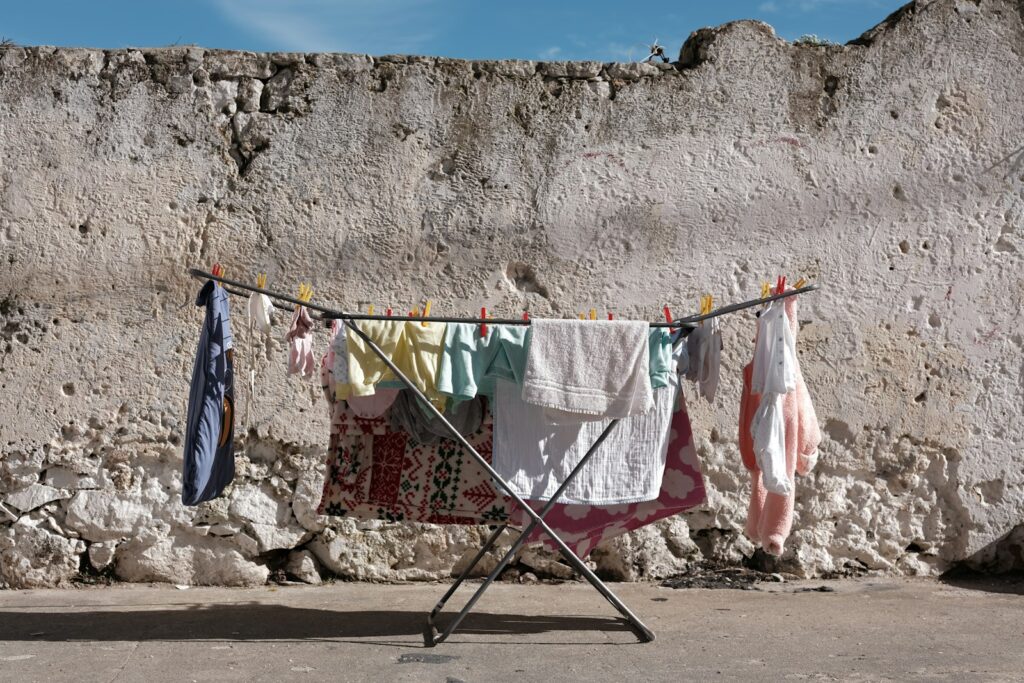 One load gives off about 2 liters of water as it air-dries, so put the rack where that moisture can leave, keep it 3 feet from the space heater, count inches of rail before you buy, space and turn the heavy things, watch humidity and window condensation, and know what the dryer you’re skipping really costs: indoor drying with the math.
- Hat, Glove and Scarf Storage by the Door: One Bin Per Person, Sized to What They Actually Wear
 Keep a daily set plus one dry spare per person, size an open bin for each from a quick measurement, dry wet mittens before they go in, clip pairs together, hang woven scarves and fold knits, skip long scarves on the playground and wash wool before it’s sealed away: a hat and glove station with a worked bin-size example.
- Guest Room That Doubles as Storage: Pick the Bed by Floor Space, Keep the Window Clear
 Count the nights the room really hosts, compare bed footprints before comfort, put storage on one wall behind a curtain, keep the window and door clear, leave guests half the closet and one drawer, and pack a single guest bin: a storage room that turns into a guest room in fifteen minutes, with a worked 10 by 11 foot example.
- Dining Room Storage for Holiday Hosting: Measure the Walkway First, Then Fit the Sideboard
 Measure the table with the leaf in, leave 44 inches where people walk and 32 where nobody passes, subtract the sideboard’s depth before you buy, anchor the hutch and give the leaf, extra chairs and holiday linens a home: dining room storage planned for the biggest night of the year, with a worked placement example.
- Winter Car Emergency Kit: 12 Things to Pack and Where Each One Should Ride
 Start from the National Weather Service list, put the heavy gear in one strapped-down trunk bin, keep the blanket, light and charger in the cabin and the scraper in the door, and know the stranded-car basics: twelve ideas for a winter car kit that stays packed until February.