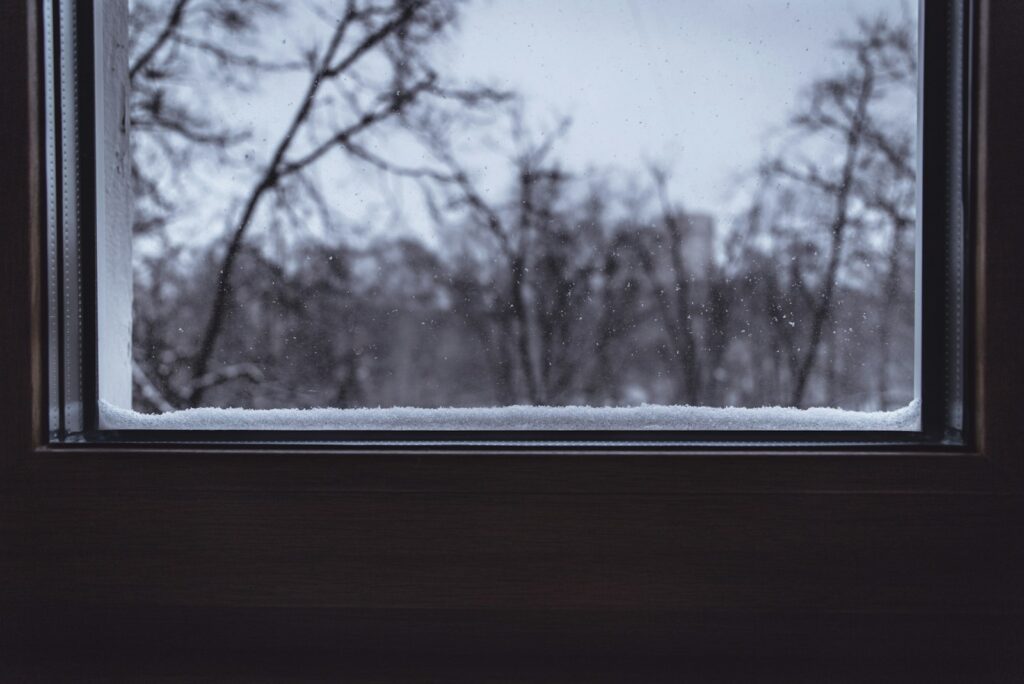
The first really cold morning of the year is when most people notice it: the bedroom window is fogged from the bottom up, there’s a little pool of water on the sill, and by January the corners of the frame have started to look gray. Window condensation in winter isn’t a mystery, and it usually isn’t the window’s fault. It’s the meeting point of two things you can measure, how much moisture is in the room and how cold the glass gets, and once you know which of those you can change, the fix is mostly free. The first job, though, is working out which side of the glass the water is on, because that decides whether you’re dealing with a humidity problem or a window problem.

Wipe the fogged glass from inside. If it clears, the moisture is coming from the room, and the answer is lower indoor humidity: the colder it is outside, the lower it has to go. A window industry chart puts the ceiling at about 40% relative humidity when it’s 20 to 40°F outside and 30% when it’s 0 to 10°F. Buy a cheap hygrometer, check it on cold mornings, run the bath and kitchen fans, turn the humidifier down, open the curtains in daytime and dry any wet sill the same day. If the fog is trapped between two panes, the seal has failed; humidity won’t fix it, so check the warranty.
Find out which side the water is on
Pella’s guide to foggy windows sorts condensation into three places: on the room side of the glass, on the outside, and between the panes of an insulated window. Each one has a different cause, so this two-minute check comes before anything else.
1. The wipe test
Run a dry cloth or paper towel across the fogged area from inside the room. If the glass clears and the cloth comes away wet, the moisture is on the room side. That’s the common winter case, and the rest of this guide is mostly about it. If the cloth stays dry and the glass is still cloudy, the fog is somewhere you can’t reach.
2. Fog you can’t wipe away: between the panes
Double- and triple-pane windows are sealed units. Pella explains that the seals between the panes eventually break down and let moisture in; a drying material inside the spacer soaks up what it can, and once that’s saturated the glass fogs between the layers. Pella notes this is most often seen on older windows and on the sunny side of the house, where extra heat speeds up the seal failure. No amount of dehumidifying reaches the inside of a sealed unit, so this one is a repair, not a habit change.
Try it if the haze looks the same no matter what the humidity is doing and sits behind smooth, dry glass on both sides. Look up the window maker and the install date; Pella, for one, says most of its product warranties cover glass for at least 20 years.
3. Water on the outside of the glass
Pella describes outdoor condensation as the summer version: it forms when the inside of the house is much cooler than the humid air outside, the same way a cold drink sweats on a hot day. On a winter morning it’s rare, and outside moisture on good glass isn’t a sign anything is wrong indoors. If you see water outside in winter, it’s more likely rain, snowmelt or frost than condensation from your home.
Why the room side fogs up in winter
The Fenestration and Glazing Industry Alliance (FGIA), the trade group that writes condensation test standards for windows, lists three ingredients: indoor glass that’s colder than the dew point of the room air, high indoor humidity, and cold outdoor temperatures. Warm air holds more moisture than cool air. When room air touches glass that’s colder than its dew point, the extra moisture comes out as water or frost on the surface.
That’s why the problem gets worse as the weather does. On a mild day the glass stays warm enough. On a 5°F morning the same room air, holding the same moisture, suddenly finds a surface cold enough to drop it. FGIA adds that kitchens, bathrooms and basements have more potential for condensation, and skylights more than wall windows because warm, moist air rises.
Indoor moisture comes from ordinary life. The University of Minnesota Extension lists bathing, cooking, washing dishes and simply breathing, plus houseplants, humidifiers, firewood stored indoors, plumbing leaks and unvented appliances. FGIA adds aquariums and fresh paint or masonry from a recent project. Drying laundry indoors belongs on that list too; our guide to drying clothes indoors in winter covers where to put the rack so its moisture can leave.
The number to aim for: humidity by outdoor temperature
FGIA publishes a chart of recommended maximum indoor relative humidity for a room at 70°F, based on how cold it is outside. It’s the same set of figures many window makers print in their condensation guides.
| Outdoor temperature | Keep indoor relative humidity at or below |
|---|---|
| 20 to 40°F | 40% |
| 10 to 20°F | 35% |
| 0 to 10°F | 30% |
| -10 to 0°F | 25% |
| -20 to -10°F | 20% |
| Below -20°F | 15% |
Two other figures put that chart in context. The EPA’s mold guide recommends keeping indoor humidity below 60%, ideally between 30 and 50%. The University of Minnesota Extension says moisture problems may start above 50%, and that roughly 25% in winter to 50% in summer is generally comfortable for people and better for the house. In other words, the cold-weather targets above are lower than what’s comfortable in fall, and the colder your winters, the further you’ll need to come down.
Worked example: one week of cold mornings
The EPA notes that a humidity meter, or hygrometer, costs roughly $10 to $50 at hardware stores. Put one in the room with the worst window, read it first thing in the morning (when the glass is coldest), and compare it with the overnight low. Here’s a week in a bedroom where the hygrometer reads 41% every morning.
| Morning | Overnight low | Chart maximum | Room reading | Points over (reading minus maximum) |
|---|---|---|---|---|
| Monday | 34°F | 40% | 41% | 1 |
| Tuesday | 18°F | 35% | 41% | 6 |
| Wednesday | 6°F | 30% | 41% | 11 |
| Thursday | -4°F | 25% | 41% | 16 |
The humidity in the room never changed, but the gap grew from 1 point to 16 points as the nights got colder, which is why the same window that was clear on Monday is streaming by Thursday. The practical takeaway: you don’t need to hold 25% all winter. Watch the forecast and lower the moisture when a cold snap is coming, starting with the steps below. If you can get the room from 41% down to 30%, an 11-point drop, you’ve matched the chart for every night down to 0°F in this example.
The chart assumes a 70°F room, and FGIA notes that condensation potential also varies with climate, altitude and where the window is in the house, so treat it as a starting point and let your own windows tell you whether you’re close.
Seven ways to bring the moisture down
1. Run the exhaust fans every time
The EPA recommends running the bathroom fan or opening a window while showering, and using exhaust fans or opening windows when cooking or running the dishwasher. The University of Minnesota Extension also suggests checking that existing fans actually work.
2. Turn the humidifier down or off
FGIA lists adjusting your home’s humidifier as one of its first steps. A whole-house humidifier set for fall comfort can be far too high for a January cold snap, so recheck the setting against the chart whenever the forecast drops.
3. Open curtains and blinds during the day
FGIA points out that keeping curtains and blinds closed during daylight raises the odds of condensation and the moisture damage that can follow. Open them in the morning. Insulating curtains still help on cold nights, as our cheap ways to keep the house warmer explain; just open them again in daylight and wipe any water you find behind them.
4. Keep the air moving
FGIA compares this to running the defroster in your car: ceiling fans throughout the house and exhaust fans as needed help clear excess moisture. The EPA also suggests raising the air temperature and increasing air movement to prevent condensation. A furniture piece or a deep window seat cushion pushed right up to the glass blocks that airflow, so leave a gap.
5. Crack a window for a few minutes
The University of Minnesota Extension suggests briefly opening windows a little in winter to let warm, moist air out and cold, dry air in. It feels backward, but cold outdoor air holds very little moisture, so a short airing after showers or a big cooking session lowers indoor humidity quickly.
6. Move the moisture sources
Firewood, a crowd of houseplants, an aquarium or a drying rack in a small bedroom can each add enough moisture to tip a cold room over the line. Store firewood outside or in the garage, group plants in a room with better ventilation, and dry laundry where a fan can reach it.
7. Add a dehumidifier when the rest isn’t enough
FGIA and Pella both name a dehumidifier as an option when the other steps don’t bring humidity down. It’s most useful in basements and in rooms with no exhaust fan. If the whole house runs damp even after these steps, FGIA suggests talking to an HVAC professional about options such as whole-house ventilation.
Skip it if the only problem is a little fog on the coldest mornings that clears by mid-morning. That’s normal at the extremes; on a -15°F day FGIA’s chart calls for 20% or less, below the roughly 25% the University of Minnesota Extension calls comfortable in winter, so perfectly clear glass may not be worth the dry air.
Protect the sill and frame
Condensation that stays put is what does the damage. The EPA’s advice is to act quickly when you see condensation on windows, walls or pipes: dry the wet surface and reduce the source. In practice that means a towel on the sill on the worst mornings and a quick wipe of the glass and the frame’s bottom rail before you leave for the day. Keep one old towel just for that job; our small bathroom towel storage ideas cover giving in-use towels room to dry between wipes.
If dark spots have already appeared on a painted sill or vinyl frame, the EPA says to scrub mold off hard surfaces with detergent and water and dry them completely, and not to paint or caulk over mold, since paint applied over it is likely to peel. Wear gloves. For a patch under about 10 square feet, roughly 3 feet by 3 feet, the EPA says most people can handle the cleanup themselves; larger areas or anything tied to a leak are a job for an experienced professional. Fix the moisture first, or the spots come back.
Air leaks around the frame make glass and trim colder, which makes condensation more likely. Our guide to the places your home is losing heat shows how to find and seal them, and window checks fit neatly into the winter home maintenance checklist.
Affiliate disclosure: As an Amazon Associate I earn from qualifying purchases. The links below are Amazon searches, not specific products we’ve tested or recommend over others.
- Digital indoor hygrometer (Amazon search) ↗
- Microfiber cloths for wiping glass (Amazon search) ↗
- Absorbent strips for window sills (Amazon search) ↗
- ENERGY STAR dehumidifier (Amazon search) ↗
For a dehumidifier, check the listed capacity against the size of the room and whether it can drain continuously before you buy.
- Wipe test done: room side, between panes or outside.
- Between-pane fog: window maker, install date and warranty looked up.
- Hygrometer placed in the room with the worst window.
- Morning reading compared with the chart for the overnight low.
- Bath and kitchen fans run during and after showers and cooking; fans tested.
- Humidifier setting lowered before cold snaps.
- Curtains and blinds open in daylight; furniture pulled back from the glass.
- Firewood, extra plants and drying racks moved out of the coldest rooms.
- Wet sills dried the same day; any mold on hard surfaces scrubbed with detergent and water.
- Air leaks around frames found and sealed.
Do I need new windows to stop condensation?
Usually not. Pella and FGIA both treat high indoor humidity as a cause of room-side condensation and lowering it as the first fix. Warmer glass does help: FGIA notes windows are rated for condensation resistance under three systems, AAMA’s CRF, NFRC’s CR and CSA’s I, with higher numbers meaning better resistance. Compare windows only within the same system if you’re replacing anyway.
Is it safe to ignore a little condensation?
A light fog that clears by mid-morning is common in deep cold. Water that runs onto the sill or sits on the frame day after day is different: the EPA says to dry wet surfaces quickly and reduce the moisture source, because damp materials are where mold gets started.
I rent. What can I do?
Everything in the seven steps above works in a rental. The EPA advises renters to report plumbing leaks and moisture problems to the building owner or manager right away. Ask the landlord about any window with fog trapped between the panes, since that’s a problem with the window itself.
Sources: Fenestration and Glazing Industry Alliance, Understanding Indoor Condensation · University of Minnesota Extension, Controlling moisture problems in your home · U.S. EPA, A Brief Guide to Mold, Moisture and Your Home · Pella, What Causes Windows to Fog?. General guidance; for persistent moisture or mold, consult a qualified professional.

Keep reading
More guides for your space
THE KINDRED JOURNAL
Latest from the journal
- Winter Storm Emergency Kit: What to Pack and Where Each Part Should Live in the House
 Store a gallon of water per person per day for several days, split the kit into a light grab-and-go bin by the exit, a cool stay-put shelf for the heavy water and food, and a flashlight in every bedroom, keep generators 20 feet out, and check it all every spring and fall: a winter storm kit with a worked family-of-four example.
- Window Insulation Film: Does It Work? Sort Your Windows First, Then Do the Math
 Shrink film adds about R-1 and stops sash drafts, so it roughly halves heat loss through single-pane glass but barely helps a tight low-e window: sort your windows with the paper test, work out one window’s savings, keep the tape on trim and plan the way out of bedrooms.
- What Holiday Lights Really Cost to Run: LED vs. Incandescent, With the Math for Your Own Display
 Read the watts off each tag, multiply by your hours and your own rate, and the answer is clear: eight incandescent strings cost about $25.70 a season in our worked example and their LED versions about $2.18, big C9 bulbs pay back an LED swap in about three seasons, and working mini lights can wait.
- Ideal Indoor Humidity in Winter: Find Your Number, Check Your Meter, Then Add Only What the Room Needs
 Aim for 30 to 50% and never humidify past 50%, let the windows set the limit on the coldest nights, salt-test your hygrometer before you trust it, seal drafts first because a whole bedroom needs only about 4½ ounces of water, and clean the tank on a schedule: a winter humidity guide with the math worked out.
- Toy Storage Ideas: 13 Ways to Make Room Before the Holiday Toy Wave
 Edit the toys before the gifts arrive, give each kind of play one open bin on an anchored low shelf, keep small parts and spare batteries out of a toddler’s reach, skip latching lids and rotate the extras: thirteen toy storage ideas for the weeks before and after the holidays.
- Best Gift Wrap Organizers: 5 Picks for a Closet Corner, Under the Bed or the Back of a Door
 An upright box that holds up to 32 long rolls, a 41.5-inch under-bed bag for big collections, a water-resistant zip bag, an over-the-door organizer and a slim canvas case for eight rolls: five gift wrap organizers matched to the space you can give them.
- Cord and Cable Storage: 13 Ideas for the Spare Chargers, Cables and Adapters Nobody Can Find
 Match every cable to a device you still own, keep a sensible number of spares by connector type, coil them loosely, label the mystery bricks, hang the extension cords and send old batteries and dead cables to a proper drop-off: thirteen ways to store spare cords so the right one turns up in seconds.
- Window Condensation in Winter: Find Which Side the Water Is On, Then Match Humidity to the Forecast
 Do the wipe test to tell room-side fog from a failed seal, check a hygrometer against the outdoor low, keep humidity at or under 40% above 20°F and 30% below 10°F, run the fans, open the curtains by day and dry wet sills the same morning: a window condensation guide with a worked cold-week example.
- How to Clean a Range Hood Filter Before Holiday Cooking: Know Your Filter Type, Then Put It on the Calendar
 Wash metal mesh and baffle filters in hot soapy water or the dishwasher, replace charcoal filters instead of rinsing them, never run the hood with the filter out, and clean the weekend before Thanksgiving and again before Christmas: a range hood filter guide with a worked holiday cleaning calendar.