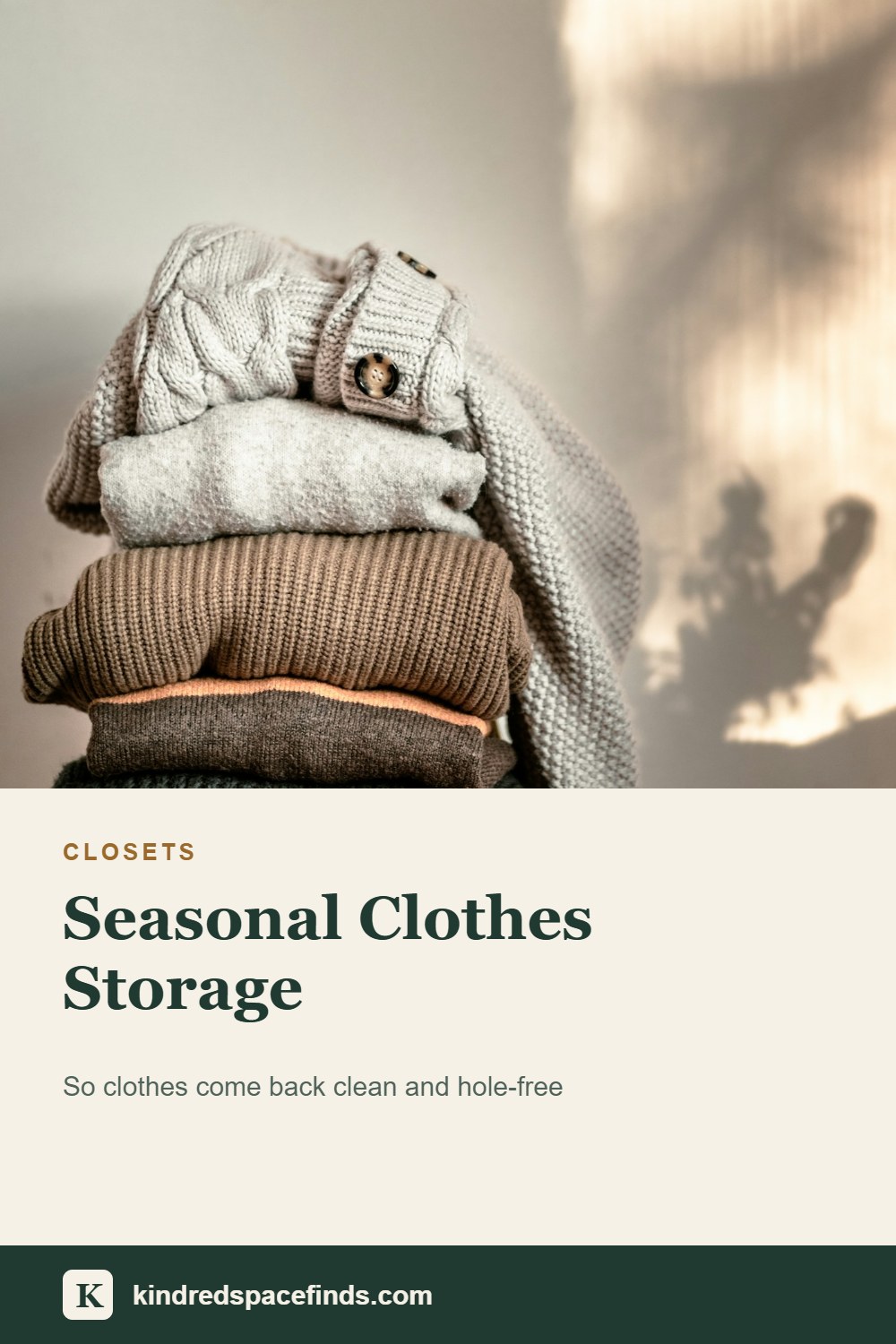
Most seasonal-storage disappointments are set up on the day you pack. A linen shirt goes into a bin with a faint sunscreen mark, and next spring it comes out with a yellow stain that won’t wash out. A wool sweater gets folded away after one wear, and carpet beetles find it before you do. The swap itself takes an afternoon. Doing it in the right order is what keeps your clothes in the shape you left them.

Sort, then wash or dry-clean everything that’s going away, even if it looks clean. Pack it dry into containers bugs can’t get into, store it somewhere cool, dark and dry (not the basement or attic), label the outside, and check on it once or twice before you need it again.
1. Sort into three piles
Pull every out-of-season piece from the closet and dresser, not just the obvious ones. Make three piles:
- Store: things you wore this season and want back.
- Keep out: layering pieces that work year-round, like light cardigans, T-shirts for under sweaters, and one pair of shorts for the gym.
- Let go: anything you didn’t wear all season, that doesn’t fit, or that’s stretched or stained beyond saving.
The “let go” pile matters more than it seems. Every item you don’t store is one less thing to wash, pack and find room for.
2. Clean everything that’s going away
This is the step people skip, and it’s the one that causes the most damage. Mississippi State University Extension advises that clothes be clean and dry before storage, and notes that wool and silk should be dry-cleaned. Stains you can’t see yet, like body oils, deodorant or sunscreen, can set over the months and become impossible to remove later.
Cleaning also protects against insects. West Virginia University Extension notes that soiled fabric attracts carpet beetles, and clean garments are less appealing to them. Wool, silk, felt and fur are the fibers clothes moths and carpet beetles go for.

3. Measure the spot before you buy bins
Decide where the stored clothes will live, then size the containers to that spot, not the other way around. Measure the depth of the shelf, the clearance above it, and the width you can give up.
Under the bed works the same way: measure the clearance from floor to frame and subtract a little for the bin to slide. Our under-bed storage guide walks through that measurement.
4. Choose the right container
WVU Extension recommends storing cleaned clothes in tightly sealed containers, and Mississippi State notes that moths and carpet beetles can’t lay eggs on clothing they can’t reach. That makes a lidded bin with a snug lid the everyday default. The other options have their places.
| Container | Good for | Watch out for |
|---|---|---|
| Lidded plastic bin | Most folded clothes, especially knits | Pack only clean, fully dry clothes; a sealed bin also traps moisture |
| Fabric bin or box | Clothes you’ll rotate soon, kept inside a closet | Not bug-tight; dust gets in |
| Vacuum storage bag | Bulky items when space is tight | Deep creases; check the care label before compressing down or anything with loft |
| Breathable garment bag | Coats, suits and dresses that stay on hangers | Zip it fully closed so insects can’t get in |
| Acid-free tissue and cotton muslin | Heirlooms, christening gowns, vintage pieces | Store flat and check every few months |
A note on plastic: University of Kentucky Extension’s guide to textile heirlooms advises avoiding plastic bags for those pieces and wrapping them in clean cotton or acid-free tissue instead. For everyday clothes, a clean, sealed bin is the practical choice; for the wedding dress or a grandparent’s quilt, follow the heirloom advice.
5. Pick a cool, dry, dark spot
Mississippi State advises against storing clothes in basements because of their typically high humidity, and says attics, while dry, get hot enough to damage fibers. University of Kentucky Extension puts it in numbers for heirloom textiles: a stable 65 to 70°F, humidity of 40 to 50 percent, and a warning that humidity over 55 percent promotes mildew. It also recommends a dark spot, since light fades fabric.
In most homes that means a closet shelf, under a bed, or an interior closet away from exterior walls. If your only option is a basement, a small hygrometer tells you whether the humidity there is actually a problem before you commit.

6. Handle pests safely
- Skip loose mothballs in closets and drawers. University of Florida IFAS notes that mothball labels list an airtight container as the only approved place to use them, and that small children and pets may mistake them for candy. WVU Extension warns their vapors are toxic, especially to children. Clean clothes in sealed bins are the safer route.
- Don’t count on cedar alone. Both Mississippi State and WVU describe cedar’s protection as limited; WVU notes it helps only while the wood’s aromatic oils are fresh.
- Check in once or twice. UK Extension suggests inspecting stored textiles every four to six months. Look for small holes, larvae or their shed skins, which WVU lists as signs of an infestation.
7. Label, then set up the winter closet
Label each bin on the side that faces out, with what’s inside and whose it is: “Summer: Maya, shorts and tees.” Then load the closet for the season ahead. Put the clothes you’ll wear most at eye level and arm’s reach, and move heavy coats to a rod with enough space for them; our coat closet guide shows how much rod a puffer really takes. Folded sweaters keep their shape better on a shelf than on hangers, and shelf dividers stop the stacks from toppling.
Supplies for the swap
Affiliate disclosure: As an Amazon Associate I earn from qualifying purchases. These links open Amazon search results for each type of item, not recommendations for a specific model we’ve tested. Check the dimensions against your shelf or under-bed space before ordering.
- Everything out of season pulled from closet and dresser.
- Store, keep-out and let-go piles made.
- Store pile washed or dry-cleaned, then fully dry.
- Storage spot measured; one test bin packed.
- Bins closed tight and labeled on the outward side.
- Stored somewhere cool, dark and dry.
- Calendar reminder set to check the bins in a few months.
Questions
Are vacuum storage bags bad for clothes?
They save a lot of space for bulky things like comforters and fleece, but they press creases into whatever’s inside. Check the care label before compressing down or anything that depends on its loft, and don’t vacuum-seal anything that isn’t completely dry.
Should I hang or fold stored winter coats?
Coats are usually best left on sturdy hangers in a breathable garment bag, cleaned first. Knit sweaters do better folded, since hanging can stretch the shoulders.
What about expensive furs?
WVU Extension notes that expensive furs are often best placed in professional cold storage at a dry cleaner.
Sources: Mississippi State University Extension, Prep winter items for safe seasonal storage · West Virginia University Extension, Carpet Beetles (PDF) · University of Kentucky Cooperative Extension, Caring for Your Textile Heirlooms (PDF) · UF/IFAS, The Facts about Mothballs. General guidance; follow the care label on each garment. See our editorial policy.
Keep reading
More guides for your space
THE KINDRED JOURNAL
Latest from the journal
- Ideal Indoor Humidity in Winter: Find Your Number, Check Your Meter, Then Add Only What the Room Needs
 Aim for 30 to 50% and never humidify past 50%, let the windows set the limit on the coldest nights, salt-test your hygrometer before you trust it, seal drafts first because a whole bedroom needs only about 4½ ounces of water, and clean the tank on a schedule: a winter humidity guide with the math worked out.
- Toy Storage Ideas: 13 Ways to Make Room Before the Holiday Toy Wave
 Edit the toys before the gifts arrive, give each kind of play one open bin on an anchored low shelf, keep small parts and spare batteries out of a toddler’s reach, skip latching lids and rotate the extras: thirteen toy storage ideas for the weeks before and after the holidays.
- Best Gift Wrap Organizers: 5 Picks for a Closet Corner, Under the Bed or the Back of a Door
 An upright box that holds up to 32 long rolls, a 41.5-inch under-bed bag for big collections, a water-resistant zip bag, an over-the-door organizer and a slim canvas case for eight rolls: five gift wrap organizers matched to the space you can give them.
- Cord and Cable Storage: 13 Ideas for the Spare Chargers, Cables and Adapters Nobody Can Find
 Match every cable to a device you still own, keep a sensible number of spares by connector type, coil them loosely, label the mystery bricks, hang the extension cords and send old batteries and dead cables to a proper drop-off: thirteen ways to store spare cords so the right one turns up in seconds.
- Window Condensation in Winter: Find Which Side the Water Is On, Then Match Humidity to the Forecast
 Do the wipe test to tell room-side fog from a failed seal, check a hygrometer against the outdoor low, keep humidity at or under 40% above 20°F and 30% below 10°F, run the fans, open the curtains by day and dry wet sills the same morning: a window condensation guide with a worked cold-week example.
- How to Clean a Range Hood Filter Before Holiday Cooking: Know Your Filter Type, Then Put It on the Calendar
 Wash metal mesh and baffle filters in hot soapy water or the dishwasher, replace charcoal filters instead of rinsing them, never run the hood with the filter out, and clean the weekend before Thanksgiving and again before Christmas: a range hood filter guide with a worked holiday cleaning calendar.
- Drying Clothes Indoors in Winter: Where the Rack Goes, How Much Rail You Need and What It Saves
 One load gives off about 2 liters of water as it air-dries, so put the rack where that moisture can leave, keep it 3 feet from the space heater, count inches of rail before you buy, space and turn the heavy things, watch humidity and window condensation, and know what the dryer you’re skipping really costs: indoor drying with the math.
- Hat, Glove and Scarf Storage by the Door: One Bin Per Person, Sized to What They Actually Wear
 Keep a daily set plus one dry spare per person, size an open bin for each from a quick measurement, dry wet mittens before they go in, clip pairs together, hang woven scarves and fold knits, skip long scarves on the playground and wash wool before it’s sealed away: a hat and glove station with a worked bin-size example.
- Guest Room That Doubles as Storage: Pick the Bed by Floor Space, Keep the Window Clear
 Count the nights the room really hosts, compare bed footprints before comfort, put storage on one wall behind a curtain, keep the window and door clear, leave guests half the closet and one drawer, and pack a single guest bin: a storage room that turns into a guest room in fifteen minutes, with a worked 10 by 11 foot example.