Picture the living room on the afternoon of December 26: new toys still in their boxes, last year’s toys under the couch, a bag of tissue paper nobody has carried out, and a two-year-old holding a building piece that belongs to a seven-year-old’s set. The fix isn’t a bigger toy box. It’s doing a little sorting now, while the shelves are only last year’s level of full, and giving every kind of toy one obvious place before the new ones land. These thirteen ideas cover the pre-holiday edit, storage kids can actually use, the safety checks that matter most with little ones in the house, and a plan that still works in February.
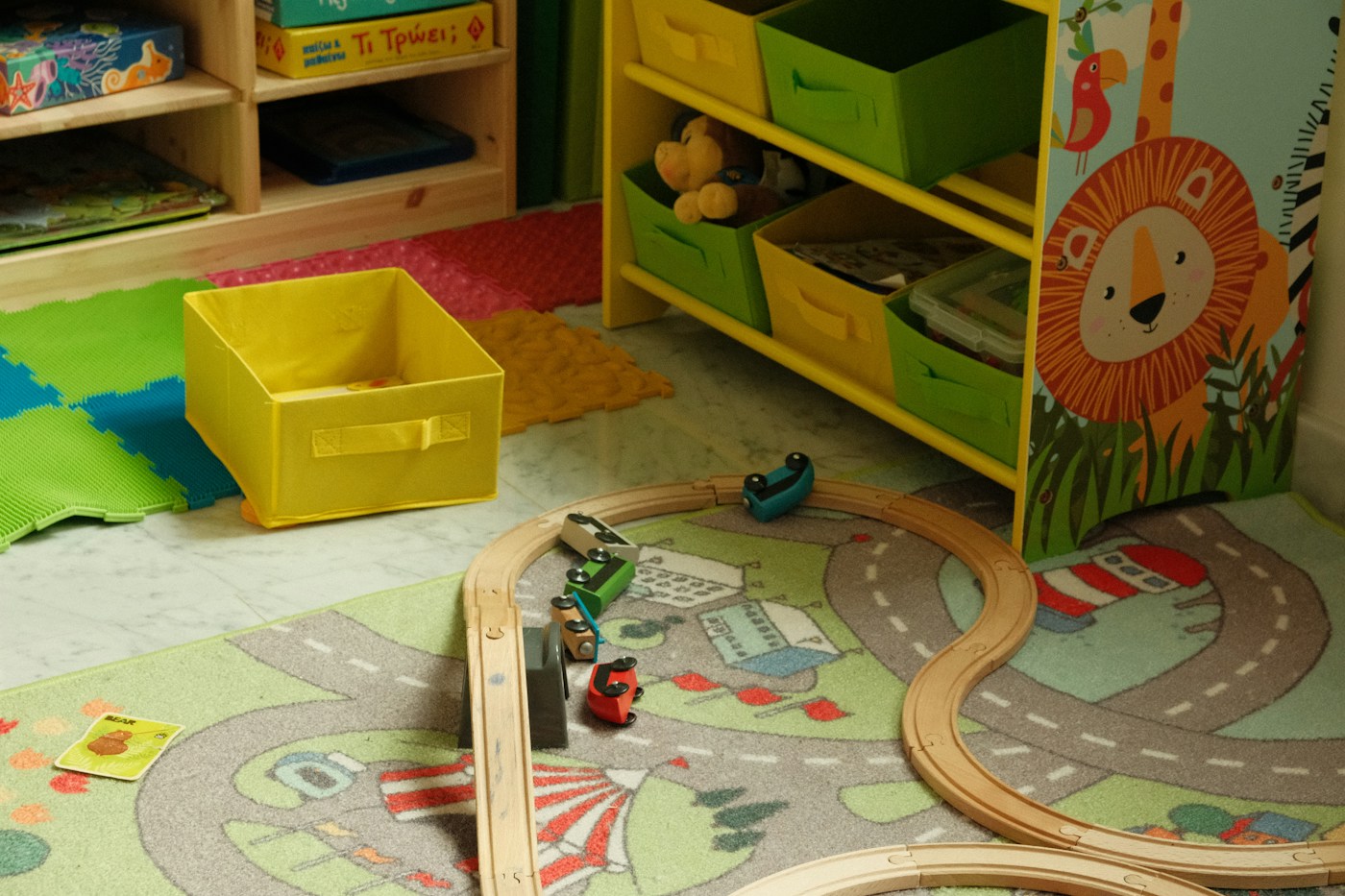
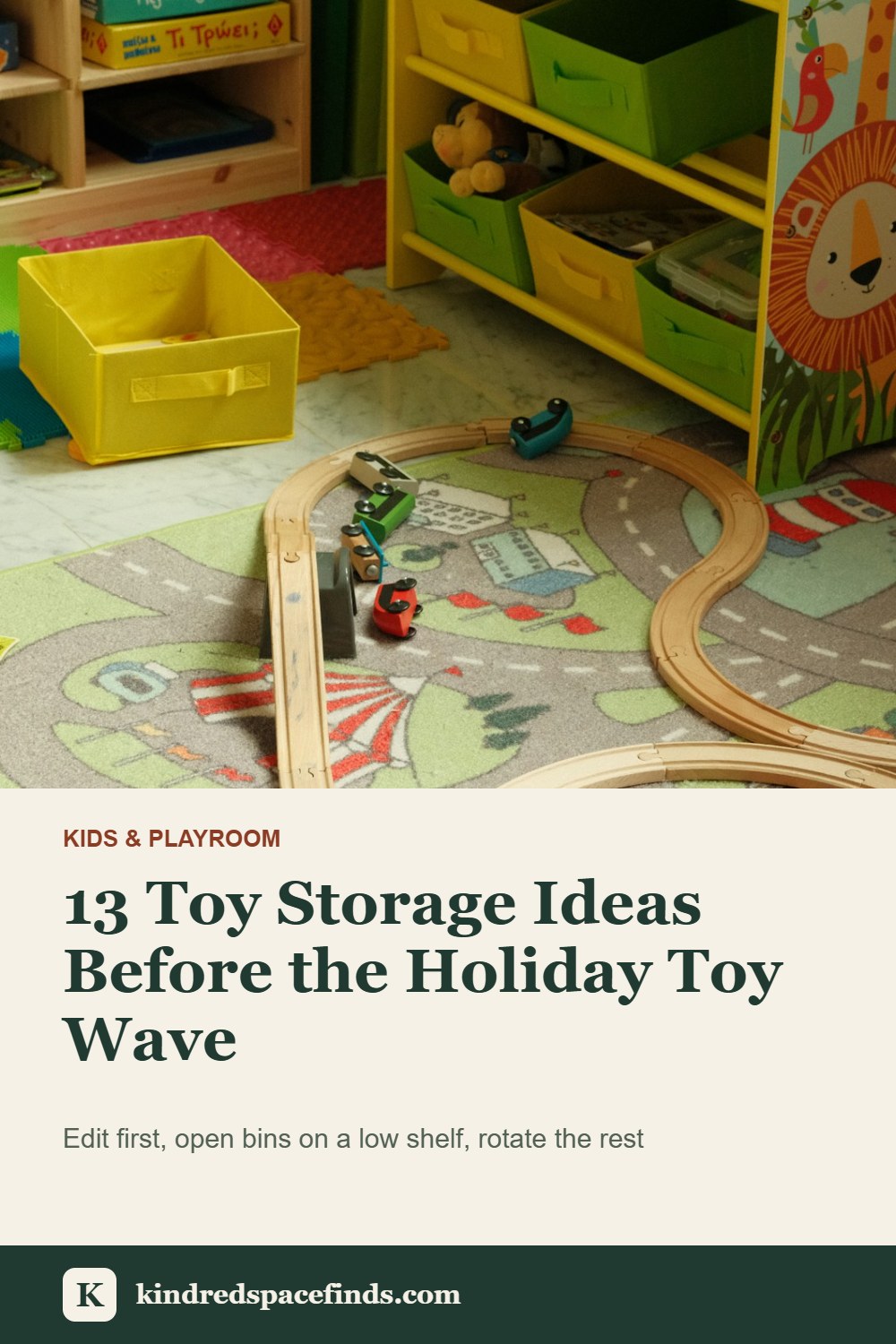
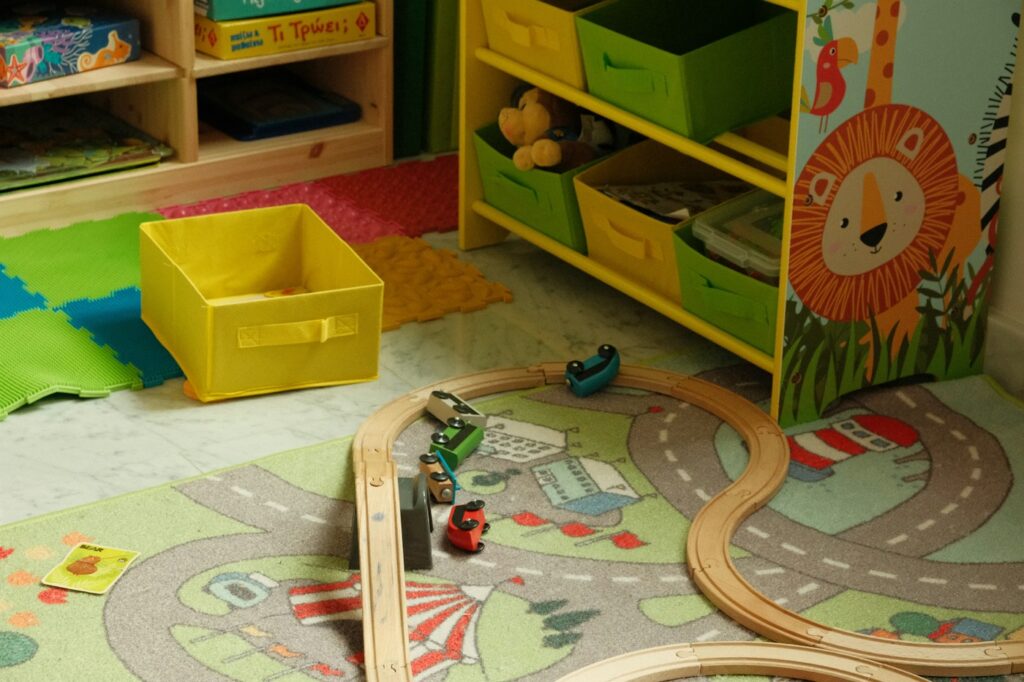
Edit the toys before the holidays, not after. Sort what stays by the kind of play it’s for, then give each category one open bin on a low shelf that’s anchored to the wall. Keep sets with small parts, spare button batteries and magnet toys up high if anyone under 3 lives or visits. Skip chests with latching lids. Put the extras in a rotation bin in a closet, and give new gifts a landing basket until they earn a permanent spot.
Make room before the new toys arrive
1. Do the edit in November, not on December 26
It’s far easier to decide what goes when the shelves are full of familiar toys than when they’re buried under new ones. Pick a weekend, pull everything into one room and make three piles: keep, pass on, and broken. Kids over about five can help decide; for toddlers, it’s usually simpler to sort while they’re napping.
Try it if the toy shelves were already full in October. Skip it if you did a full sort recently; just clear one bin’s worth of space for the new arrivals.
2. Check recalls before you pass anything on
Hand-me-downs and donations are a good home for outgrown toys, but not for recalled ones. Search the toy or the brand on CPSC’s recall list before it goes in the donation bag, and toss anything cracked, with loose small pieces or with a battery door that won’t stay shut. Federal law prohibits selling a product that’s under a recall, and the same thinking applies to giving one away.
3. Sort by the kind of play, not the size of the toy
Kids look for “the cars” or “the dress-up stuff,” not “the medium bin.” Sort what you’re keeping into a handful of play categories: building, vehicles, pretend play and dolls, art, puzzles and games, books, stuffed animals. Most households land somewhere between six and ten categories. That number tells you how many containers you need before you shop.
Store it where they play
4. One open bin per category, at their height
Open bins on a low shelf are the easiest storage for a child to use on their own: they can see in, pull it out and dump it back without wrestling a lid. Put one category in each bin and add a picture label (a photo or a drawing of the cars, not the word “vehicles”) so pre-readers can clean up without asking where things go. Our label maker comparison covers printers that handle bin labels.
If you’re buying a cube shelf and bins, measure the opening first. Many cube units are built around openings of roughly 13 inches, but sizes vary by brand, so check yours before ordering bins.
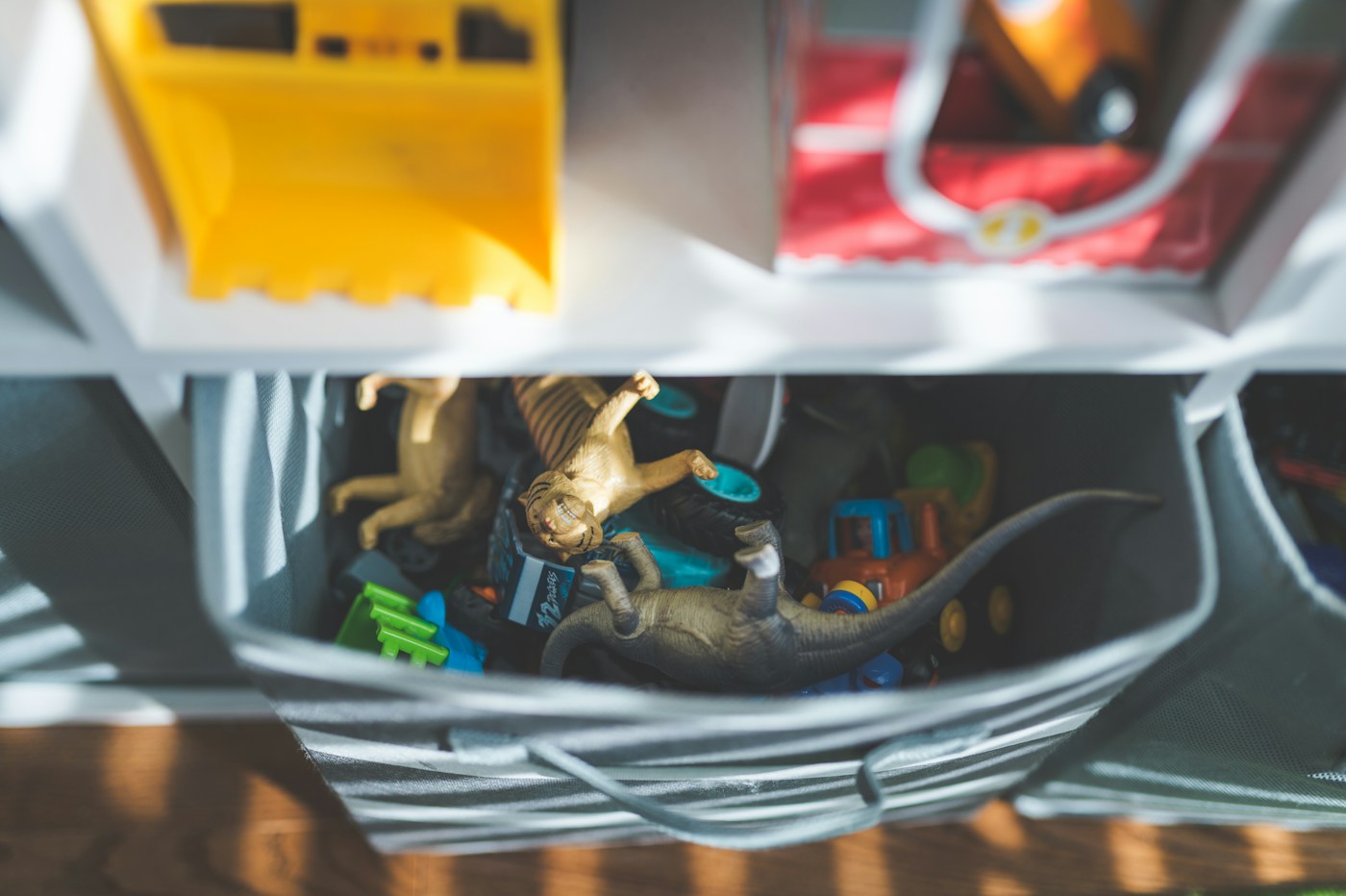
5. Anchor the shelf before the bins go in
A toy shelf is exactly the kind of furniture a child pulls on or climbs to reach the top. CPSC’s Anchor It! campaign urges families to anchor bookcases, dressers and TVs securely to the wall, and its data shows young children are the ones most often hurt in tip-overs. Use the anti-tip kit that came with the shelf, or buy one if it didn’t, and attach it to a stud or with anchors rated for your wall. Keep the toys kids want most on the low shelves so there’s nothing tempting on top.
6. Skip latching lids, or make the toy chest safe
A classic toy chest can be fine, but CPSC has warned for years about chests whose lids latch shut or slam down. Its guidance: disable or remove any automatic latch, make sure the lid support holds the lid open in any position (or replace it with a spring-loaded support that does), and keep the chest’s ventilation holes clear of the wall and the floor. If you’re inheriting an old cedar or hope chest, check it against those points before it goes in a child’s room. A lidless bin or a basket avoids the problem entirely. The same checks apply to a blanket chest in the living room.
7. In the living room, give toys a closed cabinet or one big basket
Not every family wants the living room to look like a playroom. A low cabinet with doors, a TV console with one cubby set aside, or a single large basket that holds the day’s toys lets the room reset in a minute. Keep it to one container per child so it doesn’t spread across every surface. Our entertainment center guide covers keeping remotes and consoles separate from the toy zone.
8. Give every small-piece set its own zip pouch
Building sets, play food, doll accessories and card games vanish into the general toy pile. A mesh or clear zip pouch per set, labeled with the set name, keeps the pieces together and makes it obvious when something is missing. File the pouches upright in a bin like folders so kids can see every set at once.
Keep the little ones safe in mixed-age homes
9. Put small parts on the high shelf
CPSC rules bar small parts from toys meant for children under 3, and the agency advises keeping small balls and toys with small parts away from that age group, since choking is behind most toy-related deaths it hears about. In a house with a toddler and an older sibling, the older child’s sets are the risk. Store them on a high shelf or in the older child’s room, and play with them at a table the toddler can’t reach. Watch the toy labels too: a “not for children under 3” warning means the toy has small parts.
10. Batteries and magnets go up and away
Holiday toys bring spare batteries into the house. CPSC advises keeping button and coin batteries away from children, and keeping remotes and electronics out of reach if the battery compartment isn’t closed with a screw (tape can help secure one). Put spare batteries in a closed container on a high shelf, not loose in the toy bin or a kitchen drawer. CPSC also warns that high-powered magnet sets should be kept away from kids under 14, and that building sets with small magnets don’t belong near young children. Our junk drawer guide has more on storing household batteries.
Make it last past January
11. Set up a rotation bin
Not everything you keep has to be out at once. Leave enough toys on the low shelf to fill the bins without overflow, put the rest in one or two lidded bins on a closet shelf, and swap a few toys every couple of weeks. A toy that comes back after a month away often gets played with like it’s new, and the shelf stays small enough for a child to tidy. Label the rotation bins by category so you’re not digging through all of them.
Try it if the shelves fill up the day after you organize them. Skip it if your kids already have a small, manageable set of toys.
12. Give new gifts a landing basket
On the holiday itself, set out one empty basket for each child’s new things. Open, assemble and play, but let the basket be where gifts live for the first week instead of scattering around the house. CPSC suggests throwing away plastic wrapping from toys right away so little kids can’t play with it, so keep a trash bag next to the gift pile, not across the room. After a week, each new toy either gets a bin or replaces something that moves to the rotation bin or the donation bag.
13. Do a five-minute reset before bed
Toys left on the floor are a tripping hazard, a point CPSC has made in its holiday toy safety tips for decades. A short nightly pickup, with a timer or a song, keeps the system working: everything back in its bin, the living-room basket emptied into the playroom, the small-parts sets back on the high shelf. If bins keep overflowing at reset time, that’s the signal to move a few things to the rotation bin.
Worked example: two kids, one shelf
Here’s how the ideas above might come together for a household with a 2-year-old and a 7-year-old who share a playroom corner and the living room. Your categories and counts will differ.
| Category | Who uses it | Where it lives | Container |
|---|---|---|---|
| Big blocks | Both | Low shelf | Open bin |
| Vehicles | Both | Low shelf | Open bin |
| Pretend play and dolls | Both | Low shelf | Open bin |
| Stuffed animals | Both | Floor beside shelf | One basket |
| Board books | 2-year-old | Low shelf | Front-facing bin |
| Small-piece building sets | 7-year-old | High shelf | Zip pouches in a lidded box |
| Puzzles and games | 7-year-old | High shelf | Upright, lids taped or banded |
| Art supplies | 7-year-old | High shelf, used at the table | Caddy |
| Rotation extras | Both | Closet shelf | 2 lidded bins |
That’s four open bins and a basket a toddler can reach, three containers up high, and two in the closet. With a cube shelf of eight openings anchored to the wall, the bottom row of four holds the shared bins and the top row holds the older child’s sets, leaving the top surface empty. For more on art supplies, see our craft supply storage ideas.
Affiliate disclosure: As an Amazon Associate I earn from qualifying purchases. The links below are Amazon searches, not specific products we’ve tested or recommend over others.
- Cube shelf with fabric bins (Amazon search) ↗
- Furniture anti-tip kit (Amazon search) ↗
- Picture labels for toy bins (Amazon search) ↗
- Mesh zip pouches for toy sets (Amazon search) ↗
- Large woven basket for the living room (Amazon search) ↗
Measure the shelf openings first, and buy containers after the sort, not before.
- Toys sorted into keep, pass on and broken.
- Pass-on toys checked against CPSC recalls.
- Keepers grouped by kind of play.
- One open, picture-labeled bin per category on a low shelf.
- Shelf, dresser and TV anchored to the wall.
- Any toy chest: no latch, lid stays open in any position, vents clear.
- Small-part sets, spare batteries and magnet toys up high.
- Rotation bin on a closet shelf.
- A landing basket and a trash bag ready for gift day.
How many toys should be out at once?
There’s no right number. A practical test: everything that’s out should fit in its bin with room to spare at cleanup time. If the bins overflow, move some toys to the rotation bin rather than adding more bins.
Is toy storage a good holiday gift?
For a family that’s short on space, a set of bins or an anchored shelf can be more welcome than another toy. Our gifts for organized people has more ideas.
Where do toys go when we have holiday guests?
The living-room basket can move to a bedroom for the visit, and a closed cabinet keeps the rest out of sight. Our guide to making room for holiday guests covers the rest of the house.
Sources: CPSC, Dangers of Storage and Toy Chests · CPSC, Anchor It! campaign · CPSC, Home Safe Home for the Holidays · CPSC, Button Battery Safety · CPSC, Tips for Safe Gifts · CPSC Recalls. General guidance; follow each product’s instructions and age labels.
Keep reading
More guides for your space
THE KINDRED JOURNAL
Latest from the journal
- Window Insulation Film: Does It Work? Sort Your Windows First, Then Do the Math
 Shrink film adds about R-1 and stops sash drafts, so it roughly halves heat loss through single-pane glass but barely helps a tight low-e window: sort your windows with the paper test, work out one window’s savings, keep the tape on trim and plan the way out of bedrooms.
- What Holiday Lights Really Cost to Run: LED vs. Incandescent, With the Math for Your Own Display
 Read the watts off each tag, multiply by your hours and your own rate, and the answer is clear: eight incandescent strings cost about $25.70 a season in our worked example and their LED versions about $2.18, big C9 bulbs pay back an LED swap in about three seasons, and working mini lights can wait.
- Ideal Indoor Humidity in Winter: Find Your Number, Check Your Meter, Then Add Only What the Room Needs
 Aim for 30 to 50% and never humidify past 50%, let the windows set the limit on the coldest nights, salt-test your hygrometer before you trust it, seal drafts first because a whole bedroom needs only about 4½ ounces of water, and clean the tank on a schedule: a winter humidity guide with the math worked out.
- Toy Storage Ideas: 13 Ways to Make Room Before the Holiday Toy Wave
 Edit the toys before the gifts arrive, give each kind of play one open bin on an anchored low shelf, keep small parts and spare batteries out of a toddler’s reach, skip latching lids and rotate the extras: thirteen toy storage ideas for the weeks before and after the holidays.
- Best Gift Wrap Organizers: 5 Picks for a Closet Corner, Under the Bed or the Back of a Door
 An upright box that holds up to 32 long rolls, a 41.5-inch under-bed bag for big collections, a water-resistant zip bag, an over-the-door organizer and a slim canvas case for eight rolls: five gift wrap organizers matched to the space you can give them.
- Cord and Cable Storage: 13 Ideas for the Spare Chargers, Cables and Adapters Nobody Can Find
 Match every cable to a device you still own, keep a sensible number of spares by connector type, coil them loosely, label the mystery bricks, hang the extension cords and send old batteries and dead cables to a proper drop-off: thirteen ways to store spare cords so the right one turns up in seconds.
- Window Condensation in Winter: Find Which Side the Water Is On, Then Match Humidity to the Forecast
 Do the wipe test to tell room-side fog from a failed seal, check a hygrometer against the outdoor low, keep humidity at or under 40% above 20°F and 30% below 10°F, run the fans, open the curtains by day and dry wet sills the same morning: a window condensation guide with a worked cold-week example.
- How to Clean a Range Hood Filter Before Holiday Cooking: Know Your Filter Type, Then Put It on the Calendar
 Wash metal mesh and baffle filters in hot soapy water or the dishwasher, replace charcoal filters instead of rinsing them, never run the hood with the filter out, and clean the weekend before Thanksgiving and again before Christmas: a range hood filter guide with a worked holiday cleaning calendar.
- Drying Clothes Indoors in Winter: Where the Rack Goes, How Much Rail You Need and What It Saves
 One load gives off about 2 liters of water as it air-dries, so put the rack where that moisture can leave, keep it 3 feet from the space heater, count inches of rail before you buy, space and turn the heavy things, watch humidity and window condensation, and know what the dryer you’re skipping really costs: indoor drying with the math.