When the garage walls are full, the ceiling looks like free space. Some of it is. But the ceiling also holds the garage door track, the opener, lights, and in many homes framing that wasn’t designed with storage in mind. Map what is already up there and how much room your car needs underneath, and you’ll know which overhead option fits.
Store only light, rarely used items overhead. Keep clear of the garage door’s travel path and the opener, leave room above your vehicle with its doors or hatch open, and fasten racks into ceiling framing as the manufacturer directs, never into drywall alone. If you’re unsure what the framing can carry, ask a qualified contractor before loading it.

1. Decide what belongs overhead
Ceiling storage is the hardest space in the garage to reach. That makes it right for some things and wrong for others.
- Good candidates: holiday decorations, camping gear, off-season clothing in lidded bins, empty luggage, coolers.
- Better on a wall or floor: tools you use often, heavy items, paint and chemicals, anything fragile or hard to lift.
A simple test: if you’d reach for it more than a few times a year, or you couldn’t lift it comfortably over your head while standing on a ladder, keep it lower. Our garage wall storage plan covers the reach zone.
2. Map the ceiling before you shop
Stand in the garage with a tape measure, a notepad, and the door open. Sketch the ceiling from above and mark:
- The garage door’s full travel path when open, including the horizontal tracks and the door panels themselves.
- The opener, its rail, and the emergency release cord.
- Light fixtures, smoke or heat alarms, and any attic access hatch.
- Ceiling height at the spots you’re considering. Garage ceilings vary widely, so measure yours.
- The height of your vehicle with its hatch, trunk, or doors fully open, if any of them swing upward.
- Where you walk to the door into the house, so nothing hangs above a path you use daily.
What’s left after you shade those areas is usable ceiling. Often it’s a strip along the side walls or the area above the hood of the parked car, beyond the end of the door tracks.
3. Choose the format that fits the space
| Format | Best for | Check first |
|---|---|---|
| Overhead rack (platform) | Several lidded bins of seasonal items | Load rating, drop-down height range, rack footprint versus your clear area |
| Ceiling hoist or pulley lift | One bulky item, such as a kayak, cargo box, or bike, lowered when needed | Rated load, locking mechanism, clearance to lower the item without hitting the car |
| Ceiling hooks | Ladders, bikes, or long items that hang flat or upright | Hook rating and fastening into framing; head clearance underneath |
| High wall shelf above the door | Light bins in a space the door doesn’t reach | The door and opener clearance when fully open; bracket rating and stud fastening |
An overhead rack is the most common choice for bins. A hoist makes sense for one awkward item you want to bring down without a ladder. Hooks are the simplest option but put the item’s whole weight on a few fasteners.
4. Framing and load: the step not to skip
Overhead storage hangs its full weight from the ceiling framing. That framing may be ceiling joists or engineered roof trusses, and they are not all intended to carry extra storage loads.
- Locate the framing with a stud finder and confirm with a small pilot hole. Note the spacing and direction.
- Fasten into the framing with the hardware and method the rack’s manufacturer specifies. Drywall alone won’t hold an overhead load.
- Read the rack’s weight rating, then plan to load well under it.
- If your garage has engineered trusses, a finished room above, or framing you can’t identify, ask a qualified contractor, or check the truss information if you have it, before installing.
- If you rent, get the landlord’s approval in writing before drilling into the ceiling.
Worked example: a rack above the hood
Imagine a garage with a 9-foot ceiling, or 108 inches. The parked car’s hood sits beyond the end of the door tracks, and the tallest thing in that area is the car with its front doors open, which you measure at about 70 inches. You’d like at least 6 inches of margin, so the bottom of the rack should sit no lower than 76 inches.
108 minus 76 leaves 32 inches from ceiling to the rack’s lowest point. A rack set to hang about 30 inches down puts the platform near 78 inches, which keeps the margin. Bins about 16 inches tall then top out near 94 inches, leaving about 14 inches to lift lids and slide bins out.
For weight, suppose eight bins of holiday decorations at roughly 15 pounds each, or about 120 pounds. Weigh a couple of packed bins on a bathroom scale to check. Compare the total with the rack’s rating and keep a comfortable margin under it.
5. Safety checklist
- Never mount storage where the garage door or its tracks travel, and keep the opener and emergency release cord clear and reachable.
- Don’t block light fixtures, smoke or heat alarms, sprinklers, or the attic hatch.
- Use lidded bins on racks so nothing slides off, and keep the heaviest bins near the rack’s supports.
- Use a stable ladder with a helper to hand bins up and down. Don’t stand on the car or on a bin.
- Keep fuel, paint, and chemicals off the ceiling; store them as their labels direct.
- Check fasteners and the rack for loosening or sagging from time to time.
6. What to buy, and in what order
- A stud finder, if you don’t have one.
- Matching lidded bins, so you know their size and weight before choosing a rack.
- An overhead rack sized to your clear area and drop height, or a hoist for a single bulky item.
- Ceiling hooks for a ladder or bikes, only after the rack is placed.
Ready to compare specific models? Our overhead garage storage rack comparison lines up five options by listed size, capacity, drop range and what they mount to.
Compare garage ceiling storage
Affiliate disclosure: As an Amazon Associate I earn from qualifying purchases. These links open Amazon search results for the formats in this guide, not recommendations for a specific model. Check weight ratings, drop height, and mounting requirements before buying.
Questions
How much weight can a garage ceiling hold?
It depends on the framing, its spacing, and what’s above it, so there’s no single number. Follow the rack manufacturer’s installation and load guidance, and ask a qualified contractor if you aren’t sure what your framing is.
Can I put a rack above the garage door?
Only if the rack sits entirely outside the door’s travel path when the door is fully open, and clear of the opener. Measure with the door open, not closed.
Are overhead racks a good idea for renters?
They require drilling into the ceiling framing, so ask your landlord first. A freestanding shelf unit anchored to a wall is often easier to get approved.
Related: Best overhead garage storage racks · How to store Christmas lights

Keep reading
More guides for your space

THE KINDRED JOURNAL
Latest from the journal
- What Holiday Lights Really Cost to Run: LED vs. Incandescent, With the Math for Your Own Display
 Read the watts off each tag, multiply by your hours and your own rate, and the answer is clear: eight incandescent strings cost about $25.70 a season in our worked example and their LED versions about $2.18, big C9 bulbs pay back an LED swap in about three seasons, and working mini lights can wait.
- Ideal Indoor Humidity in Winter: Find Your Number, Check Your Meter, Then Add Only What the Room Needs
 Aim for 30 to 50% and never humidify past 50%, let the windows set the limit on the coldest nights, salt-test your hygrometer before you trust it, seal drafts first because a whole bedroom needs only about 4½ ounces of water, and clean the tank on a schedule: a winter humidity guide with the math worked out.
- Toy Storage Ideas: 13 Ways to Make Room Before the Holiday Toy Wave
 Edit the toys before the gifts arrive, give each kind of play one open bin on an anchored low shelf, keep small parts and spare batteries out of a toddler’s reach, skip latching lids and rotate the extras: thirteen toy storage ideas for the weeks before and after the holidays.
- Best Gift Wrap Organizers: 5 Picks for a Closet Corner, Under the Bed or the Back of a Door
 An upright box that holds up to 32 long rolls, a 41.5-inch under-bed bag for big collections, a water-resistant zip bag, an over-the-door organizer and a slim canvas case for eight rolls: five gift wrap organizers matched to the space you can give them.
- Cord and Cable Storage: 13 Ideas for the Spare Chargers, Cables and Adapters Nobody Can Find
 Match every cable to a device you still own, keep a sensible number of spares by connector type, coil them loosely, label the mystery bricks, hang the extension cords and send old batteries and dead cables to a proper drop-off: thirteen ways to store spare cords so the right one turns up in seconds.
- Window Condensation in Winter: Find Which Side the Water Is On, Then Match Humidity to the Forecast
 Do the wipe test to tell room-side fog from a failed seal, check a hygrometer against the outdoor low, keep humidity at or under 40% above 20°F and 30% below 10°F, run the fans, open the curtains by day and dry wet sills the same morning: a window condensation guide with a worked cold-week example.
- How to Clean a Range Hood Filter Before Holiday Cooking: Know Your Filter Type, Then Put It on the Calendar
 Wash metal mesh and baffle filters in hot soapy water or the dishwasher, replace charcoal filters instead of rinsing them, never run the hood with the filter out, and clean the weekend before Thanksgiving and again before Christmas: a range hood filter guide with a worked holiday cleaning calendar.
- Drying Clothes Indoors in Winter: Where the Rack Goes, How Much Rail You Need and What It Saves
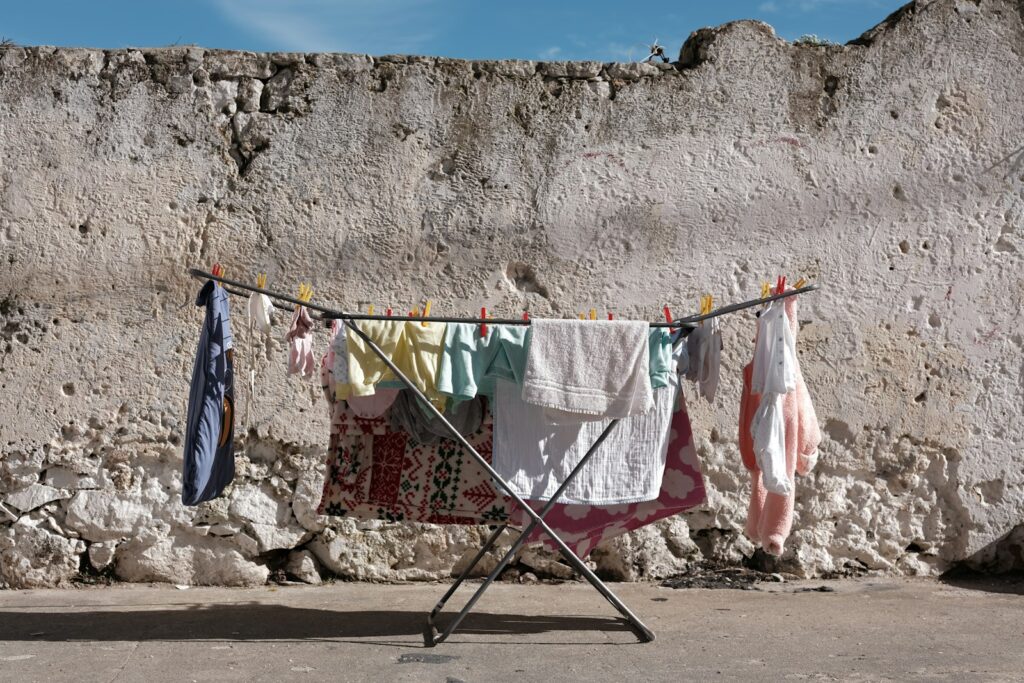 One load gives off about 2 liters of water as it air-dries, so put the rack where that moisture can leave, keep it 3 feet from the space heater, count inches of rail before you buy, space and turn the heavy things, watch humidity and window condensation, and know what the dryer you’re skipping really costs: indoor drying with the math.
- Hat, Glove and Scarf Storage by the Door: One Bin Per Person, Sized to What They Actually Wear
 Keep a daily set plus one dry spare per person, size an open bin for each from a quick measurement, dry wet mittens before they go in, clip pairs together, hang woven scarves and fold knits, skip long scarves on the playground and wash wool before it’s sealed away: a hat and glove station with a worked bin-size example.