Every December someone asks whether the lights are what pushed the electric bill up, and the honest answer is “it depends on which lights.” A string of old incandescent mini lights and a string of big glass C9 bulbs can look like the same kind of decoration, yet one draws about 41 watts and the other 175. The way to find out what your display really costs isn’t to guess or trust a headline number. It’s to read the small tag on each cord, add up the watts, and multiply by your own hours and your own rate. This guide walks through that math with real label numbers, shows a full worked example for a typical house, and then uses the result to decide which strings are worth replacing first and which can wait another year.
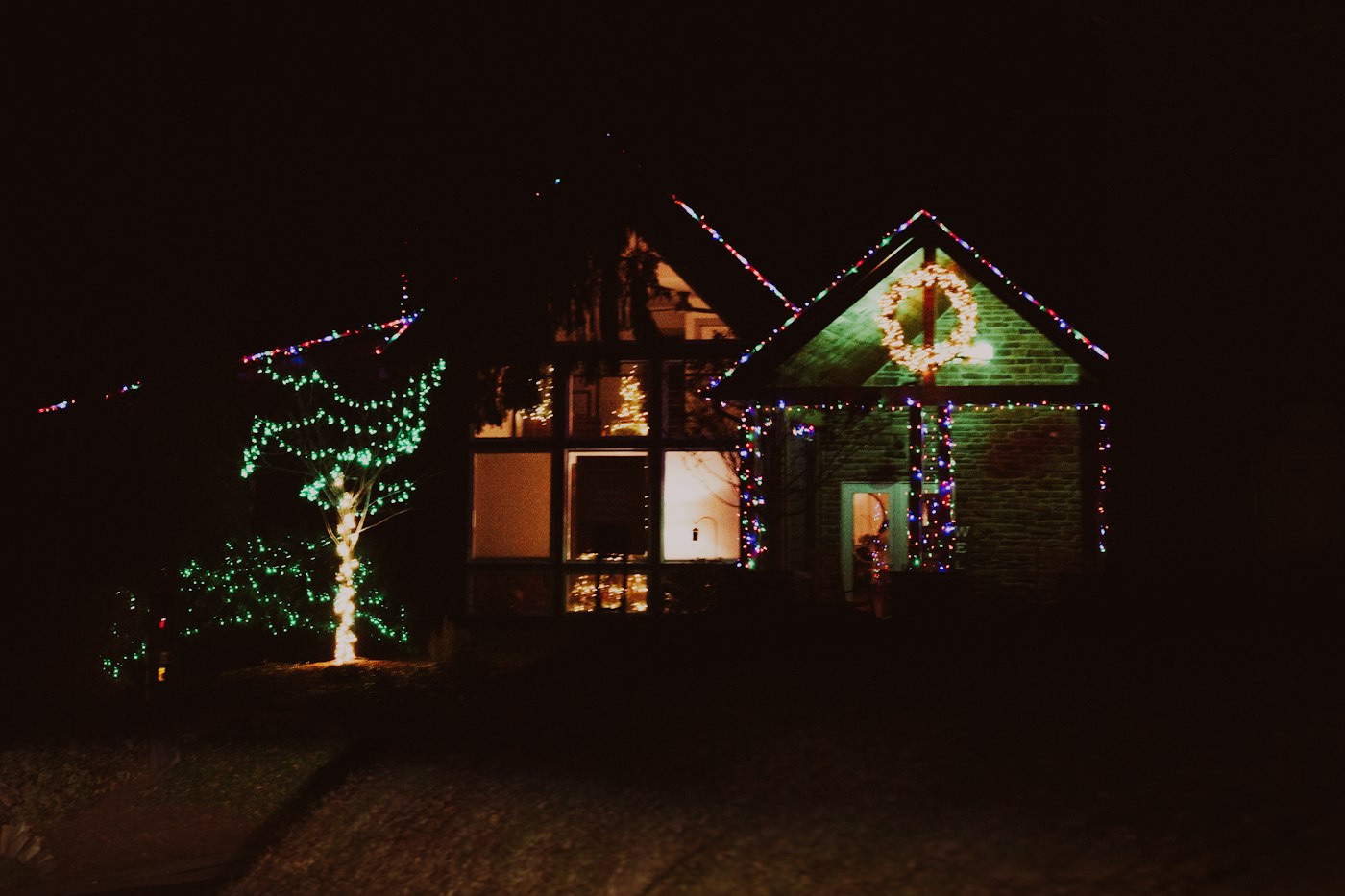
Cost per season = watts ÷ 1,000 × hours per night × nights × your price per kWh. Most light sets list their watts on the tag or box. In our worked example, eight incandescent strings run about $25.70 for a 40-night season at 18 cents per kWh, and the LED versions about $2.18. The big savings come from large C7 and C9 bulbs, which pay back an LED swap in about three seasons; incandescent mini lights already cost little to run, so replacing them is closer to a twelve-season payback. A timer that trims each night by a couple of hours saves money on any kind of light.
Step one: find the three numbers that set the cost
1. Read the watts off the tag, not the box art
Most light sets carry a small flag tag near the plug, and the same numbers are usually printed on the box and on the retailer’s product page. You are looking for a line such as “120 volts, 60 hertz, 0.34 amps, 40.8 watts.” That last figure is what the whole string draws when it’s lit. If the tag lists only amps, multiply amps by 120 to get an approximate wattage.
Here are the label figures from four ordinary light sets we looked up from one retailer in November 2026, so you can see how wide the spread is:
- 100-count incandescent mini lights: 40.8 watts (about 0.41 watt per bulb).
- 25-count incandescent C9 bulbs, 24 feet lit: 175 watts (7 watts per bulb).
- 100-count LED mini lights, 33 feet lit: 7.2 watts.
- 25-count LED C9 lights, 16 feet lit: 2.4 watts.
Notice that a single strand of old C9 bulbs draws more than four strands of incandescent minis put together. That one comparison explains most of what follows.
Try it if you still have the original boxes or can reach the plug end of each string. Skip it if the tags are long gone; jump to idea 4 and measure instead.
2. Count the hours honestly
The hours matter as much as the bulbs. A display on a dusk-to-midnight timer runs about 6 hours a night; one left on from 4:30 p.m. until someone remembers in the morning can run 14. Multiply by the number of nights: the day after Thanksgiving through New Year’s Day is about 38 nights, and many households run lights a little longer than that. We use 6 hours a night for 40 nights, or 240 hours, in the example below. Swap in your own numbers.
3. Use your own price per kWh
The U.S. Energy Information Administration’s Short-Term Energy Outlook puts the average U.S. residential price at about 18 cents per kilowatt-hour for the summer months of 2026, with regional averages from roughly 14.5 cents in the East South Central states to more than 28 cents in New England. Your real rate, including delivery charges, is on your bill. If you’ve never worked it out, our guide to reading your electric bill shows how to divide the total by the kWh used to get the number to plug in here.
4. No tag? Measure the string
A plug-in electricity usage meter or an energy-monitoring smart plug reads the watts directly. Plug the light string (or the power strip feeding a whole tree) into the meter, switch it on and read the figure. This is also the fastest way to check a pre-lit tree or an inflatable, which often don’t list watts anywhere obvious. We compared a few of these meters in our energy monitoring smart plug picks.
The worked example: one house, two kinds of lights
Picture a fairly typical display: six strands of 100-count mini lights split between the tree and the porch railing, plus 48 feet of roofline outlined in C9 bulbs. The lights run 6 hours a night for 40 nights (240 hours), and electricity costs 18 cents per kWh.
One detail people miss: the LED C9 set we looked up lights 16 feet, while the incandescent C9 set lights 24 feet. Covering the same 48-foot roofline therefore takes three LED strings instead of two. The table accounts for that. The LED minis, at 33 lit feet, actually cover more than the incandescent minis’ 20 or so, so you might need fewer of them; we’ve kept six for a simple comparison.
| Lights | Total watts | kWh per season | Cost per season |
|---|---|---|---|
| 6 incandescent mini strings (6 × 40.8 W) | 244.8 | 58.75 | $10.58 |
| 2 incandescent C9 strings (2 × 175 W) | 350 | 84.00 | $15.12 |
| Incandescent display total | 594.8 | 142.75 | $25.70 |
| 6 LED mini strings (6 × 7.2 W) | 43.2 | 10.37 | $1.87 |
| 3 LED C9 strings (3 × 2.4 W) | 7.2 | 1.73 | $0.31 |
| LED display total | 50.4 | 12.10 | $2.18 |
Here’s the arithmetic for the first row, so you can repeat it for yours: 244.8 watts ÷ 1,000 = 0.2448 kilowatts; × 240 hours = 58.75 kWh; × $0.18 = $10.58. The switch to LED saves $23.52 a season in this example.
Two quick ways to see how sensitive that is. At a New England–style rate of 28 cents, the incandescent display costs about $39.97 a season and the LED one about $3.39. Leave the same display on 12 hours a night instead of 6 and the incandescent cost doubles to about $51.39 at 18 cents, while the LED version is about $4.35. Long hours and expensive power are what turn holiday lights from a rounding error into a noticeable line on the bill.
The U.S. Department of Energy reaches a similar conclusion at a smaller scale: its Energy Saver team estimates that lighting a 6-foot tree with LEDs for 12 hours a day over 40 days can cost as little as 27 cents in electricity, versus about $10 with incandescent lights.
Which strings to replace first
The worked example hides a more useful answer than “LEDs are cheaper.” Split the savings by light type and compare them with what the new strings cost.
5. Big bulbs first: C7 and C9 strings pay back fast
Replacing the two incandescent C9 strings with three LED strings saves about $14.81 a season (342.8 fewer watts × 240 hours × 18 cents). At the $14.99 list price we saw for the LED set, three strings cost $44.97, so they pay for themselves in roughly three seasons, sooner if you run them longer or pay more for power. If your roofline, porch posts or yard trees use the large screw-in bulbs, these are the strings to retire first.
Try it if any of your strings use the large 7-watt glass bulbs. Skip it if you already own LED retrofit bulbs that screw into your existing C9 sockets; swapping bulbs can be cheaper than buying whole new strings.
6. Mini lights: replace when they fail, not before
The six incandescent mini strings cost $10.58 for the season, and their LED replacements save about $8.71. Six new LED strings at the $17.99 list price come to $107.94, which works out to about twelve seasons before the electricity savings cover the purchase. That’s a weak case for throwing out working strands. A better plan is to buy LED the next time an old mini string dies, or when you’d be buying lights anyway.
7. Watch the extras that aren’t strings at all
Inflatables, projectors, animated figures and the space heater someone plugged in to keep the porch comfortable don’t show up in a string count, and many don’t print their watts where you’d notice. If the bill still looks high after the lights are switched over, measure these with a usage meter. Our explainer on why winter electric bills jump covers the bigger seasonal loads, like heat pump backup strips, that usually matter more than decorations.
Cut the hours without cutting the display
8. Put every outlet on a timer
DOE recommends setting holiday lights on a timer so they switch on and off at set times. Going from 8 hours a night to 6 cuts the cost of any display by a quarter, and it covers the nights nobody remembers to unplug. A simple outdoor-rated plug-in timer works; a smart plug lets you change the schedule from your phone and check its wattage reading at the same time.
9. Turn everything off at bedtime and when you leave
The Electrical Safety Foundation International (ESFI) advises switching off all indoor and outdoor electrical decorations before going to sleep or leaving home. That’s a safety rule first, and a money rule second: overnight hours are the ones nobody is looking at. A timer set to end at your bedtime handles both. Our Christmas tree safety guide covers the other fire basics for indoor lights, such as keeping a cut tree watered and away from heat sources.
A quick safety check while you count watts
10. Respect the connection limit on each set
Every set has a limit on how many strings you can plug end to end. ESFI’s general advice is never to connect more than three strands of incandescent lights together. The incandescent mini set we looked at allowed up to five, with a cap of 210 watts for the chain; five strings at 40.8 watts each is 204 watts, right at that limit. Where the advice differs, follow the lower number. LED sets typically allow many more strings on one chain because each draws so little; the LED minis we checked allowed 29.
11. Inspect before you plug in
ESFI recommends checking every light set for cracked or damaged sockets, loose or bare wires and loose connections, which can cause a shock or start a fire, and buying lights approved by a nationally recognized testing laboratory. While you’re reading tags for wattage, look at the cord too. If a string is damaged, retire it rather than repairing it, and when the season ends, store the good ones the way our Christmas light storage guide describes so they’re still working next year.
Affiliate disclosure: As an Amazon Associate I earn from qualifying purchases. The links below are Amazon searches, not specific products we’ve tested or recommend over others.
- Plug-in electricity usage meter (Amazon search) ↗
- Outdoor-rated outlet timer (Amazon search) ↗
- UL-listed LED C9 light strings (Amazon search) ↗
- LED C9 retrofit bulbs for existing sockets (Amazon search) ↗
- UL-listed LED mini light strings (Amazon search) ↗
Check each listing’s watts, lit length, outdoor rating and maximum connected sets before you buy.
- Watts read from the tag, box or a usage meter for every string and decoration.
- Hours per night and number of nights written down honestly.
- Your own price per kWh taken from your bill.
- Season cost worked out: watts ÷ 1,000 × hours × nights × rate.
- Large C7/C9 incandescent strings flagged for LED replacement first.
- Working incandescent minis kept until they fail, then replaced with LED.
- Every outlet on a timer that ends at bedtime.
- Connection limits checked; the lower of ESFI’s advice and the label followed.
- Damaged sockets or frayed cords retired before the lights go up.
Do LED lights really use 90 percent less electricity?
For the sets we checked, the difference was even larger. A 100-count LED mini string at 7.2 watts uses about 82 percent less than a 40.8-watt incandescent mini string, and a 2.4-watt LED C9 string uses about 99 percent less than a 175-watt incandescent one. Exact savings depend on the specific sets, so read the tags on yours.
Is it cheaper to leave lights on or turn them on and off every day?
Turning them off is cheaper. The cost formula is driven by hours lit, so every hour a string is off is an hour you don’t pay for. That’s why DOE suggests a timer, and why it’s the simplest saving for any display.
How much do holiday lights add to a typical bill?
For a modest LED display, often only a few dollars for the whole season. A large incandescent display with C9 bulbs and long hours can run $40 to $50 or more at higher rates, as the worked example shows. Run the formula with your own watts, hours and rate to get your number.
Sources: U.S. Department of Energy, Energy Saver: We’ve Got Holiday Energy Savings All Wrapped Up · ESFI, Indoor Lights and Electrical Decorations Safety Tips · U.S. Energy Information Administration, Short-Term Energy Outlook, Table SF02 (September 2026) · Light set ratings from Northlight product listings at Christmas Central (incandescent mini), (incandescent C9), (LED mini) and (LED C9), checked November 2026. Prices and rates change; use your own figures.
Keep reading
More guides for your space
THE KINDRED JOURNAL
Latest from the journal
- Window Insulation Film: Does It Work? Sort Your Windows First, Then Do the Math
 Shrink film adds about R-1 and stops sash drafts, so it roughly halves heat loss through single-pane glass but barely helps a tight low-e window: sort your windows with the paper test, work out one window’s savings, keep the tape on trim and plan the way out of bedrooms.
- What Holiday Lights Really Cost to Run: LED vs. Incandescent, With the Math for Your Own Display
 Read the watts off each tag, multiply by your hours and your own rate, and the answer is clear: eight incandescent strings cost about $25.70 a season in our worked example and their LED versions about $2.18, big C9 bulbs pay back an LED swap in about three seasons, and working mini lights can wait.
- Ideal Indoor Humidity in Winter: Find Your Number, Check Your Meter, Then Add Only What the Room Needs
 Aim for 30 to 50% and never humidify past 50%, let the windows set the limit on the coldest nights, salt-test your hygrometer before you trust it, seal drafts first because a whole bedroom needs only about 4½ ounces of water, and clean the tank on a schedule: a winter humidity guide with the math worked out.
- Toy Storage Ideas: 13 Ways to Make Room Before the Holiday Toy Wave
 Edit the toys before the gifts arrive, give each kind of play one open bin on an anchored low shelf, keep small parts and spare batteries out of a toddler’s reach, skip latching lids and rotate the extras: thirteen toy storage ideas for the weeks before and after the holidays.
- Best Gift Wrap Organizers: 5 Picks for a Closet Corner, Under the Bed or the Back of a Door
 An upright box that holds up to 32 long rolls, a 41.5-inch under-bed bag for big collections, a water-resistant zip bag, an over-the-door organizer and a slim canvas case for eight rolls: five gift wrap organizers matched to the space you can give them.
- Cord and Cable Storage: 13 Ideas for the Spare Chargers, Cables and Adapters Nobody Can Find
 Match every cable to a device you still own, keep a sensible number of spares by connector type, coil them loosely, label the mystery bricks, hang the extension cords and send old batteries and dead cables to a proper drop-off: thirteen ways to store spare cords so the right one turns up in seconds.
- Window Condensation in Winter: Find Which Side the Water Is On, Then Match Humidity to the Forecast
 Do the wipe test to tell room-side fog from a failed seal, check a hygrometer against the outdoor low, keep humidity at or under 40% above 20°F and 30% below 10°F, run the fans, open the curtains by day and dry wet sills the same morning: a window condensation guide with a worked cold-week example.
- How to Clean a Range Hood Filter Before Holiday Cooking: Know Your Filter Type, Then Put It on the Calendar
 Wash metal mesh and baffle filters in hot soapy water or the dishwasher, replace charcoal filters instead of rinsing them, never run the hood with the filter out, and clean the weekend before Thanksgiving and again before Christmas: a range hood filter guide with a worked holiday cleaning calendar.
- Drying Clothes Indoors in Winter: Where the Rack Goes, How Much Rail You Need and What It Saves
 One load gives off about 2 liters of water as it air-dries, so put the rack where that moisture can leave, keep it 3 feet from the space heater, count inches of rail before you buy, space and turn the heavy things, watch humidity and window condensation, and know what the dryer you’re skipping really costs: indoor drying with the math.