Most messy kitchen drawers aren’t messy because of too much stuff. They’re messy because nothing has a fixed spot, so the whisk ends up with the batteries and the good spatula lives under the foil. The fix is less about buying organizers and more about deciding what each drawer is for. Here’s a plan you can work through one drawer at a time.
Affiliate disclosure: As an Amazon Associate I earn from qualifying purchases. Shopping links in this post open Amazon search results for a type of item, not a specific product we’ve tested.
Step 1: Give each drawer a job by where you stand
Stand at the stove, the sink, and the main prep counter, and think about what you reach for at each spot. Drawers should follow those spots, not tradition.
| Drawer location | Best job |
|---|---|
| Next to the stove | Cooking utensils, oven mitts, trivets |
| Near the prep counter | Knives (in a block or tray), measuring cups, peelers, can opener |
| Near the dishwasher | Everyday cutlery, so unloading takes one step |
| Near the fridge | Food storage bags, wraps, clips, labels |
| Deep drawers | Pots, lids, dishes, or food storage containers |
| The one farthest from the action | Rarely used tools and the true junk drawer |
If you only have three or four drawers, merge jobs that happen in the same spot. The goal is fewer steps while you cook.
Step 2: Empty one drawer and sort it into four piles
- Daily: things you use most days. These earn the best spots.
- Weekly or monthly: keep, but they can live lower, farther back, or in another drawer.
- Duplicates: three can openers, five spatulas. Keep the best one or two.
- Not kitchen: batteries, tape, chargers. Move them out. Our junk drawer guide gives them a home.
Wipe the drawer out before anything goes back. Crumbs in a drawer are a magnet for pests.
Step 3: Measure before you buy organizers
Organizers that don’t fit end up sliding around, which is how drawers get messy again. Measure each drawer’s inside width, depth front to back, and height, and write them down.
- Expandable cutlery trays fit standard drawers well and adjust to the width.
- Modular bins in mixed sizes work for odd-shaped utensil drawers; arrange them on the counter first to check the layout.
- Bamboo dividers that spring-load across the drawer suit deep drawers holding lids or tall tools.
- Non-slip drawer liner under everything keeps bins from shifting when the drawer opens.
Expandable cutlery trays on Amazon ↗
Step 4: Set up each type of drawer
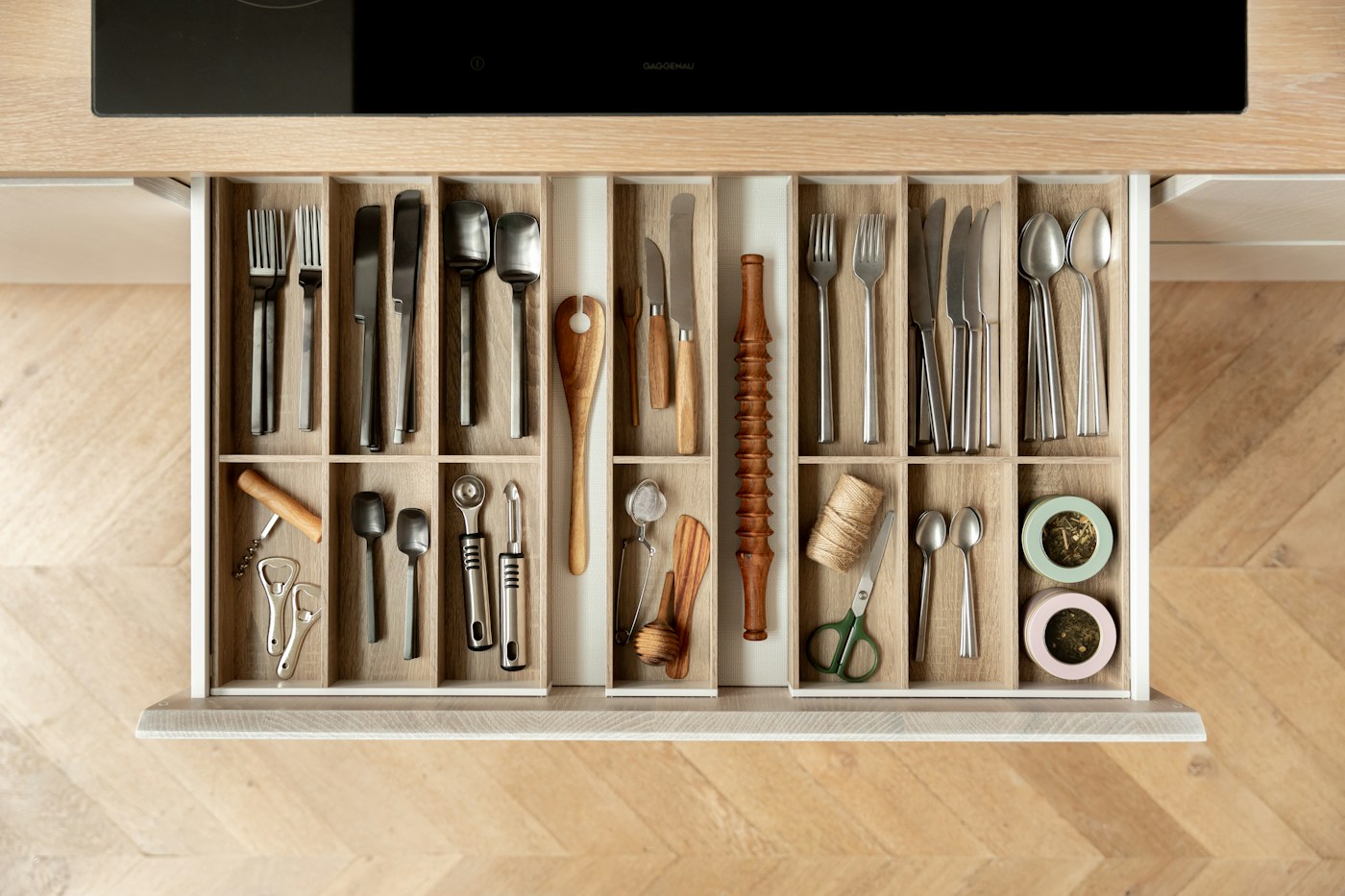
The cutlery drawer
Keep only the everyday set here, sized to your household plus a few extra for guests. Put forks, knives, and spoons in the slots closest to the front and serving pieces at the back. Steak knives belong in a separate slot or block so nobody reaches into a pile of blades.
The utensil drawer
Utensil drawers overflow because tools are long and odd-shaped. Lay them flat in one direction, handles facing you. If the drawer still won’t close, move the overflow to a crock by the stove; the ones you grab mid-cooking are good candidates. Keep the crock a step away from the burners, though; our kitchen counter organization ideas explain why and what else to clear off the counter.
The knife drawer
Loose knives dull quickly and cut fingers. Use an in-drawer knife block or a tray with individual slots, edges down or covered. Keep it out of reach of young children, or fit a child-safety latch.
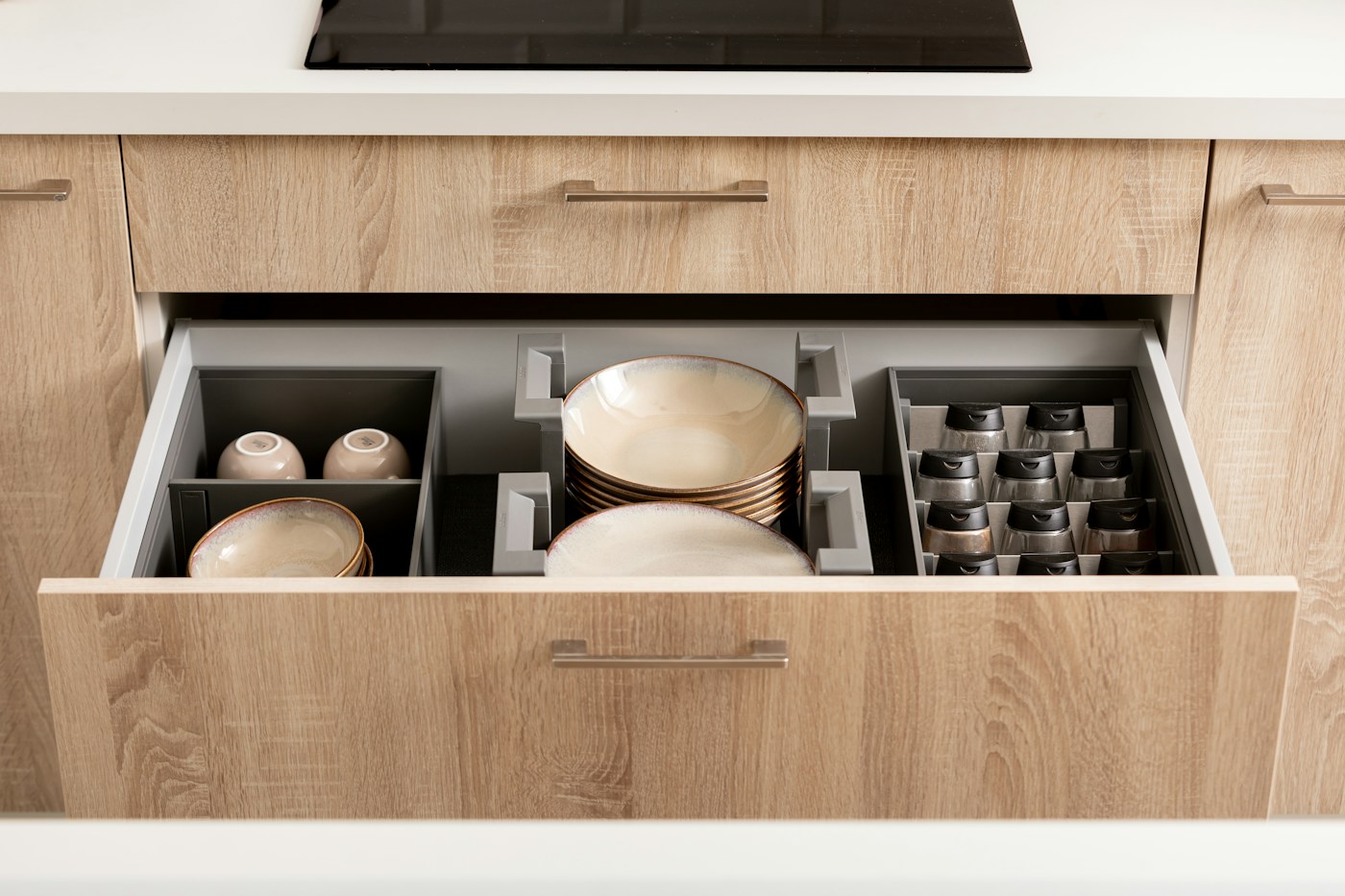
Deep drawers
Deep drawers are prime space. Use them for heavy items you’d rather not lift down from a cabinet: pots, mixing bowls, or stacks of everyday plates held in place with a peg board insert. Store pot lids upright in a divider rather than on top of each pot. Our guide to pots and pans storage covers more options.
The wrap and bag drawer
Boxes of foil, wrap, and bags lie flat side by side, front edge facing you so the labels are readable. A small bin at the back holds clips and twist ties.
Common mistakes
- Buying organizers first. Sort and measure, then buy.
- Filling every slot. Leave a little empty space so things go back easily.
- One drawer for everything sharp. Keep knives separate from other tools.
- Ignoring the back of the drawer. Put rarely used items there, not the tools you need every day.
Shopping ideas for kitchen drawers
These open Amazon search results. Check your drawer measurements before buying.
Common questions
How many utensils do I actually need?
Most home cooks get by with one or two each of a spatula, a large spoon, a slotted spoon, tongs, a ladle, and a whisk. If you have more than you can lay flat in one drawer, keep the favorites and donate the rest.
Should the cutlery drawer be next to the dishwasher?
If you can manage it, yes. Unloading becomes a single step, which is the moment drawers usually get jumbled.
What about drawers with odd shapes or corners?
Use small modular bins you can rearrange, or a spring-loaded divider cut to length. Avoid one-piece trays that leave gaps on the sides.
Keep reading
More guides for your space
THE KINDRED JOURNAL
Latest from the journal
- What Holiday Lights Really Cost to Run: LED vs. Incandescent, With the Math for Your Own Display
 Read the watts off each tag, multiply by your hours and your own rate, and the answer is clear: eight incandescent strings cost about $25.70 a season in our worked example and their LED versions about $2.18, big C9 bulbs pay back an LED swap in about three seasons, and working mini lights can wait.
- Ideal Indoor Humidity in Winter: Find Your Number, Check Your Meter, Then Add Only What the Room Needs
 Aim for 30 to 50% and never humidify past 50%, let the windows set the limit on the coldest nights, salt-test your hygrometer before you trust it, seal drafts first because a whole bedroom needs only about 4½ ounces of water, and clean the tank on a schedule: a winter humidity guide with the math worked out.
- Toy Storage Ideas: 13 Ways to Make Room Before the Holiday Toy Wave
 Edit the toys before the gifts arrive, give each kind of play one open bin on an anchored low shelf, keep small parts and spare batteries out of a toddler’s reach, skip latching lids and rotate the extras: thirteen toy storage ideas for the weeks before and after the holidays.
- Best Gift Wrap Organizers: 5 Picks for a Closet Corner, Under the Bed or the Back of a Door
 An upright box that holds up to 32 long rolls, a 41.5-inch under-bed bag for big collections, a water-resistant zip bag, an over-the-door organizer and a slim canvas case for eight rolls: five gift wrap organizers matched to the space you can give them.
- Cord and Cable Storage: 13 Ideas for the Spare Chargers, Cables and Adapters Nobody Can Find
 Match every cable to a device you still own, keep a sensible number of spares by connector type, coil them loosely, label the mystery bricks, hang the extension cords and send old batteries and dead cables to a proper drop-off: thirteen ways to store spare cords so the right one turns up in seconds.
- Window Condensation in Winter: Find Which Side the Water Is On, Then Match Humidity to the Forecast
 Do the wipe test to tell room-side fog from a failed seal, check a hygrometer against the outdoor low, keep humidity at or under 40% above 20°F and 30% below 10°F, run the fans, open the curtains by day and dry wet sills the same morning: a window condensation guide with a worked cold-week example.
- How to Clean a Range Hood Filter Before Holiday Cooking: Know Your Filter Type, Then Put It on the Calendar
 Wash metal mesh and baffle filters in hot soapy water or the dishwasher, replace charcoal filters instead of rinsing them, never run the hood with the filter out, and clean the weekend before Thanksgiving and again before Christmas: a range hood filter guide with a worked holiday cleaning calendar.
- Drying Clothes Indoors in Winter: Where the Rack Goes, How Much Rail You Need and What It Saves
 One load gives off about 2 liters of water as it air-dries, so put the rack where that moisture can leave, keep it 3 feet from the space heater, count inches of rail before you buy, space and turn the heavy things, watch humidity and window condensation, and know what the dryer you’re skipping really costs: indoor drying with the math.
- Hat, Glove and Scarf Storage by the Door: One Bin Per Person, Sized to What They Actually Wear
 Keep a daily set plus one dry spare per person, size an open bin for each from a quick measurement, dry wet mittens before they go in, clip pairs together, hang woven scarves and fold knits, skip long scarves on the playground and wash wool before it’s sealed away: a hat and glove station with a worked bin-size example.