Throw blankets multiply in winter. One lives on the sofa arm, another gets dragged in from a bedroom for movie night, a holiday gift adds a third, and by January there’s a soft heap on the end of the couch and a fleece on the floor that the dog has claimed. The problem usually isn’t the number of blankets so much as the fact that none of them has a home. A living room needs two kinds of blanket storage: an open spot for the few throws people grab every evening, and a closed one for the rest. These twelve ideas cover both, with a simple way to size a basket or ottoman before you buy one, and the safety checks that matter when blankets sit near a fireplace or inside a chest.
Keep about one throw per regular sofa sitter within arm’s reach, in an open basket or on a ladder, and store the extras in a closed ottoman, bench or closet shelf. Measure one of your throws folded before buying a container, because that one number decides whether a basket fits. Keep every blanket spot at least 3 feet from the fireplace, radiator or space heater, as the U.S. Fire Administration advises for anything that can burn. If you use a blanket chest or storage bench, make sure the lid stays open on its own and can’t latch shut. Wash wool throws before they go into closed storage, since soiled animal fibers attract clothes moths and carpet beetles.
Decide how many throws stay out
1. One per sitter, plus one
Count the people who regularly sit in the living room on a winter evening, then keep that many throws out, plus one for a guest or the person who always runs cold. A family of four needs about five within reach, not the eleven that have collected over the years. Everything beyond that number is backstock, and backstock belongs behind a lid or a door. This one decision does more to clear a sofa than any basket you can buy.
Try it if blankets pile up on the couch arms and floor. Skip it if you live alone and use one throw; drape it over the sofa back and you’re done.
2. Separate the everyday throws from the special ones
The fleece that goes in the wash every week and the wool or cashmere throw that was a gift need different storage. Washable synthetics and cotton can live in an open basket. Animal-fiber throws, such as wool, mohair or alpaca, are the ones clothes moths and carpet beetles eat, according to NC State Extension, so they’re better kept clean and in closed storage when they’re not in regular use. Heated throws are their own category too: our heated throw blanket guide covers the care and auto-off features to check, and the cord needs a spot where it won’t get pinched.
Open storage for the throws you use every night
3. A wide, low basket beside the sofa
A basket at the end of the couch is the easiest place to toss a blanket back, which is the only reason this kind of storage works. Choose a wide, open shape over a tall, narrow one: blankets get shoved in rather than folded, and a wide opening lets you see what’s there. A basket with handles is easier to carry to the laundry room on wash day. Size it using the worked example below.
4. A blanket ladder on a wall with no outlet behind it
A leaning ladder holds four or five throws, each draped over a rung, and it takes very little floor space. It does need a clear stretch of wall away from foot traffic, and it shouldn’t block an outlet or a heat register. A ladder that leans can still be knocked over by a child climbing or a pet jumping, so look for one that comes with wall hardware. The Consumer Product Safety Commission’s Anchor It! campaign recommends anchoring furniture with shelves to the wall to prevent tip-overs; a leaning ladder isn’t a bookcase, but the same habit makes sense, and anchoring kits use a wall bracket, a furniture bracket and a strap tightened between them.
Try it if you have a narrow bare wall and like seeing the throws as decor. Skip it if you have a toddler who climbs; a basket on the floor can’t fall on anyone.
5. Rolled, not folded, on open shelves
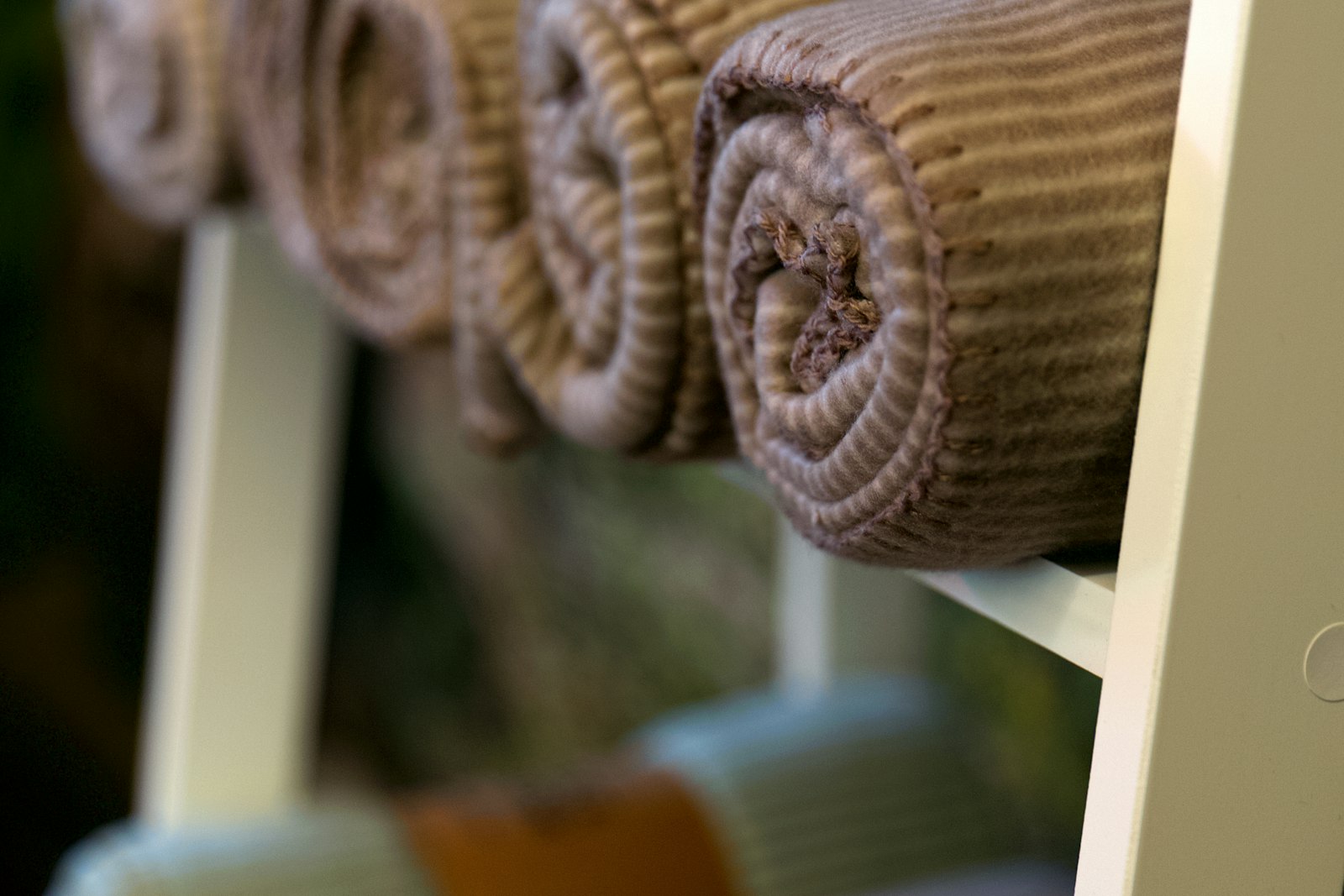
If the living room has a bookcase or built-in shelves, a shelf of rolled throws looks tidy and lets each one slide out without toppling the rest. Fold the throw lengthwise into thirds, then roll it from one short end. Rolled blankets also show their color and pattern from the front, which helps when someone wants “the gray one.” Anchor the shelf unit first, as Anchor It! advises for any furniture with shelves, especially once it’s loaded at the bottom with heavy blankets and kids might pull on them.
6. Over the sofa back, but only one
A single throw folded over the sofa back is storage, not clutter. Three is a pile. Pick the one that gets the most use and leave the rest in the basket.
Closed storage for the extras
7. A storage ottoman that doubles as a footrest
An ottoman with a lift-off or hinged top hides several throws and still works as a footrest or extra seat. Before you buy, compare the listed interior dimensions with one of your folded throws; exterior dimensions are always bigger, and padding can take a few inches off the inside. If the lid is hinged, check how it behaves when open: it should stay up on its own rather than drop.
8. A blanket chest or storage bench, with the lid checked
Blanket chests, hope chests and storage benches hold a lot, and they’ve been a classic spot for extra throws for generations. They also carry a real risk for young children. In a 2014 warning, CPSC said it had reports of 34 deaths since 1996 of children who became trapped in storage and toy chests, including blanket chests and storage benches. Two hazards stand out: lids that latch automatically and can lock a child inside an airtight chest, and lid supports that don’t hold the lid open, so it can drop onto a child’s head or neck.
CPSC’s advice for chests in use: disable or remove any automatic latch or lock and ask the manufacturer about replacement hardware; if a lid support doesn’t hold the lid open in every position, remove it or replace it with a spring-loaded support that does; and for toy chests, make sure the ventilation holes aren’t blocked by the wall or floor. An older cedar chest from a relative is worth checking for recalls before it goes in a room where kids play. For the toy side of this, keep children’s toys out of the blanket chest entirely so it never becomes the place they climb into.
Try it if you want closed storage that also gives you a bench seat. Skip it if you can’t confirm the lid stays open and the latch is gone; use an ottoman with a lift-off top instead.
9. A closet shelf or under-bed bin for the off-season
When winter ends, most throws can leave the living room altogether. A high shelf in the hall or linen closet works well; our linen closet organization guide covers shelf heights and how to give blankets their own shelf. In a small apartment, a low bin under the bed can hold several, and our under-bed storage guide explains how to measure the clearance first.
Keep throws safe and in good shape
10. Three feet from anything hot
A basket of blankets next to the fireplace looks cozy, but the U.S. Fire Administration says to keep anything that can burn at least 3 feet from fireplaces, wood stoves, radiators, space heaters and candles. Throws count. That rules out the hearth, the floor in front of a radiator and the spot right next to a space heater. USFA also says to turn space heaters off when you leave the room or go to bed, so a throw that gets dropped near one overnight isn’t sitting beside a running heater.
11. Clean wool before it goes behind a lid
NC State Extension explains that clothes moth and carpet beetle larvae feed on keratin, the protein in wool, fur, feathers and silk, and that items soiled with food, body oils or sweat are more attractive to them, including cotton and synthetics with food stains. So wash or dry-clean wool throws according to their care labels before closed storage, then store them in a sealed container. The same publication says cedar chests and closets stop protecting woolens after about two years, and that herbs in storage offer very limited protection, so cedar alone isn’t a plan. It also cautions against plastic bags for long textile storage because they limit airflow and can encourage mold; a lidded bin or a breathable cotton bag inside a sealed chest is a better choice. For a fuller pack-away routine, see our seasonal clothes storage guide.
12. Vacuum under the sofa and the ottoman
NC State’s advice for preventing fabric pests puts regular cleaning first: along walls, under rug edges and under couches, chairs and chests, where lint and hair build up. A quick pass under the sofa and around the blanket basket when you vacuum removes the debris that larvae live on and keeps a forgotten throw from becoming a nest.
Worked example: will five throws fit in that basket?
Most size guides list a standard throw at about 50 by 60 inches, with anything bigger called oversized. Fold a 50 by 60 inch throw in half four times and you get a neat rectangle:
| Fold | Size | Layers |
|---|---|---|
| Flat | 50 x 60 in | 1 |
| Half (long side) | 25 x 60 in | 2 |
| Half again | 25 x 30 in | 4 |
| Half again | 12.5 x 30 in | 8 |
| Final fold | 12.5 x 15 in | 16 |
Now measure the height of one folded throw on a table, because fabric thickness varies too much to guess. Say a fleece throw folded to 12.5 by 15 inches stands 3 inches tall. Five of them stacked would be 5 × 3 = 15 inches, so you need an interior height of at least 15 inches, plus a little room to grab them.
For a round basket, the folded rectangle has to fit across the bottom diagonally. The diagonal of a 12.5 by 15 inch rectangle is √(12.5² + 15²) = √(156.25 + 225) = √381.25 ≈ 19.5 inches. So a round basket needs an inside diameter of about 20 inches to hold the throws flat. A rectangular basket only needs an inside footprint of at least 12.5 by 15 inches. If you’d rather stand the throws on edge like files, five at 3 inches each need 15 inches of width and the basket needs to be about 12.5 inches deep front to back and at least 15 inches tall.
A queen-size throw at 60 by 80 inches, folded the same way, ends up at 15 by 20 inches, so it needs a bigger container: the diagonal works out to √(15² + 20²) = √(225 + 400) = √625 = 25 inches. That’s why oversized throws often fit better in an ottoman or chest than in a basket.
Putting it together in a small living room
In a small space, combine one open and one closed spot: a basket at the end of the sofa for the nightly throws, and an ottoman or a closet shelf for the backstock. If the room also serves as a guest room during the holidays, a cleared ottoman can hold the guest’s bedding during the day; our guide to making room for holiday guests has more ideas, and our small apartment storage ideas show furniture that hides storage without looking like it.
Affiliate disclosure: As an Amazon Associate I earn from qualifying purchases. The links below are Amazon searches, not specific products we’ve tested or recommend over others.
- Large woven blanket basket (Amazon search) ↗
- Blanket ladder with wall hardware (Amazon search) ↗
- Storage ottoman with lift-off lid (Amazon search) ↗
- Furniture anchoring kit (Amazon search) ↗
- Breathable cotton storage bags (Amazon search) ↗
Compare interior dimensions with your folded throw, and check how any hinged lid opens and closes before you buy.
- Everyday throws counted: one per regular sitter, plus one.
- Extras moved to an ottoman, bench, closet shelf or under-bed bin.
- One folded throw measured before buying a basket.
- Every blanket spot at least 3 feet from fireplace, radiator, heater and candles.
- Ladder or shelf unit anchored to the wall.
- Chest or bench lid stays open on its own; automatic latch removed.
- Wool throws cleaned before closed storage, kept in a sealed container.
- Under the sofa and ottoman vacuumed regularly.
Is a cedar chest enough to keep moths out of wool throws?
Not by itself. NC State Extension notes that cedar chests and closets stop protecting woolens after about two years. Cleaning the throws before storage and keeping them sealed matters more. If you use an inherited cedar chest, check the lid hardware as well, following CPSC’s advice to remove automatic latches.
Can I keep a blanket basket by the fireplace if the fire isn’t lit?
It’s safer to give it a permanent spot elsewhere. Baskets tend to stay where they’re put, and the U.S. Fire Administration’s 3-foot rule applies whenever the fireplace is in use. Placing the basket at the opposite end of the sofa avoids the question entirely.
Sources: U.S. Consumer Product Safety Commission, CPSC Warns Consumers of the Deadly Dangers of Storage and Toy Chests · CPSC, Anchor It! · U.S. Fire Administration, Heating Fire Safety · NC State Extension, Clothes Moths and Carpet Beetles: Controlling Fabric Pests. General guidance; follow each product’s care label and assembly instructions.
Keep reading
More guides for your space
THE KINDRED JOURNAL
Latest from the journal
- Toy Storage Ideas: 13 Ways to Make Room Before the Holiday Toy Wave
 Edit the toys before the gifts arrive, give each kind of play one open bin on an anchored low shelf, keep small parts and spare batteries out of a toddler’s reach, skip latching lids and rotate the extras: thirteen toy storage ideas for the weeks before and after the holidays.
- Best Gift Wrap Organizers: 5 Picks for a Closet Corner, Under the Bed or the Back of a Door
 An upright box that holds up to 32 long rolls, a 41.5-inch under-bed bag for big collections, a water-resistant zip bag, an over-the-door organizer and a slim canvas case for eight rolls: five gift wrap organizers matched to the space you can give them.
- Cord and Cable Storage: 13 Ideas for the Spare Chargers, Cables and Adapters Nobody Can Find
 Match every cable to a device you still own, keep a sensible number of spares by connector type, coil them loosely, label the mystery bricks, hang the extension cords and send old batteries and dead cables to a proper drop-off: thirteen ways to store spare cords so the right one turns up in seconds.
- Window Condensation in Winter: Find Which Side the Water Is On, Then Match Humidity to the Forecast
 Do the wipe test to tell room-side fog from a failed seal, check a hygrometer against the outdoor low, keep humidity at or under 40% above 20°F and 30% below 10°F, run the fans, open the curtains by day and dry wet sills the same morning: a window condensation guide with a worked cold-week example.
- How to Clean a Range Hood Filter Before Holiday Cooking: Know Your Filter Type, Then Put It on the Calendar
 Wash metal mesh and baffle filters in hot soapy water or the dishwasher, replace charcoal filters instead of rinsing them, never run the hood with the filter out, and clean the weekend before Thanksgiving and again before Christmas: a range hood filter guide with a worked holiday cleaning calendar.
- Drying Clothes Indoors in Winter: Where the Rack Goes, How Much Rail You Need and What It Saves
 One load gives off about 2 liters of water as it air-dries, so put the rack where that moisture can leave, keep it 3 feet from the space heater, count inches of rail before you buy, space and turn the heavy things, watch humidity and window condensation, and know what the dryer you’re skipping really costs: indoor drying with the math.
- Hat, Glove and Scarf Storage by the Door: One Bin Per Person, Sized to What They Actually Wear
 Keep a daily set plus one dry spare per person, size an open bin for each from a quick measurement, dry wet mittens before they go in, clip pairs together, hang woven scarves and fold knits, skip long scarves on the playground and wash wool before it’s sealed away: a hat and glove station with a worked bin-size example.
- Guest Room That Doubles as Storage: Pick the Bed by Floor Space, Keep the Window Clear
 Count the nights the room really hosts, compare bed footprints before comfort, put storage on one wall behind a curtain, keep the window and door clear, leave guests half the closet and one drawer, and pack a single guest bin: a storage room that turns into a guest room in fifteen minutes, with a worked 10 by 11 foot example.
- Dining Room Storage for Holiday Hosting: Measure the Walkway First, Then Fit the Sideboard
 Measure the table with the leaf in, leave 44 inches where people walk and 32 where nobody passes, subtract the sideboard’s depth before you buy, anchor the hutch and give the leaf, extra chairs and holiday linens a home: dining room storage planned for the biggest night of the year, with a worked placement example.